
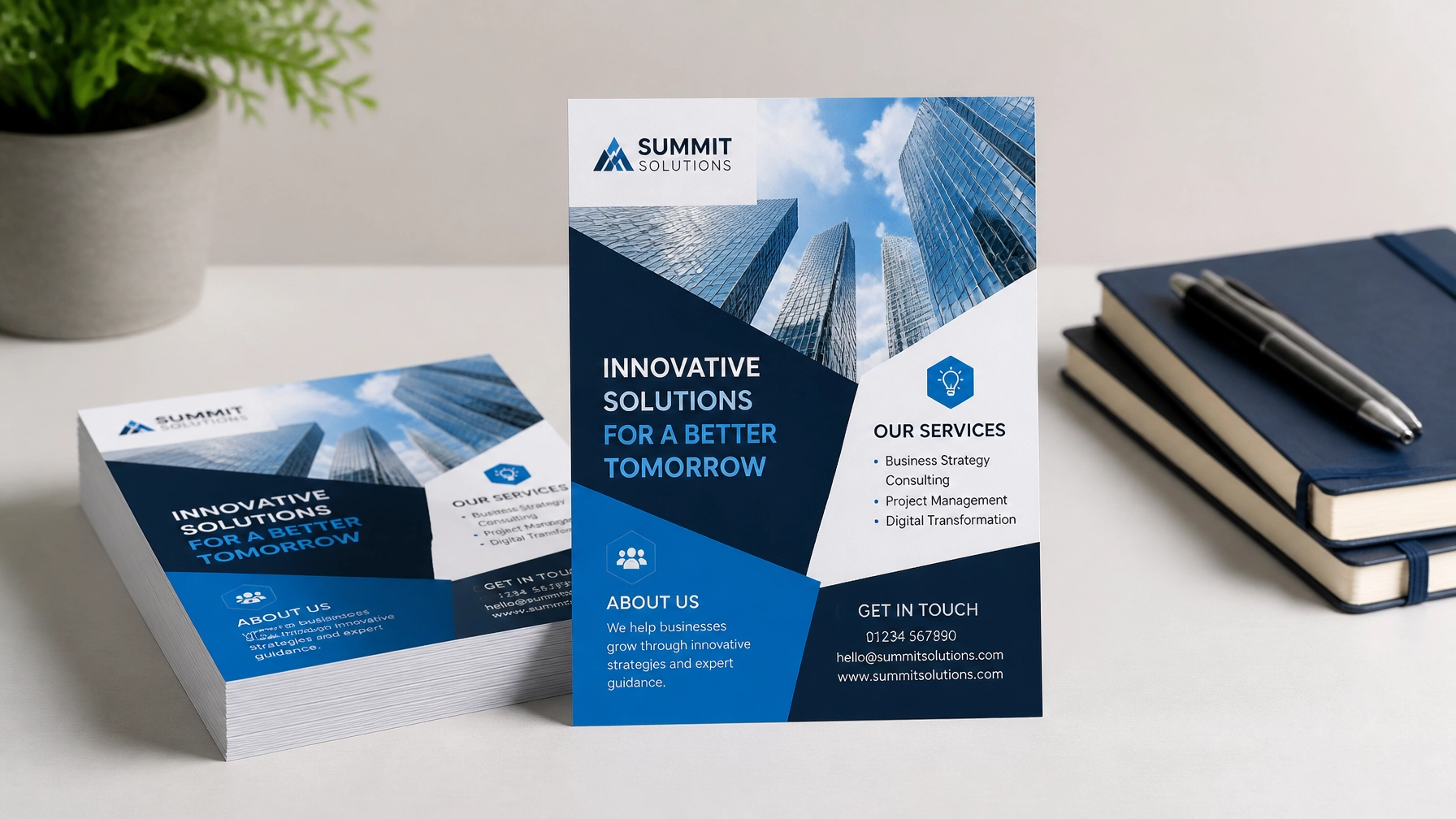
When choosing a flyer size, the most practical option is not always the largest one. A6 flyers offer a useful balance between available design space, portability and printing services efficiency.
Measuring 105 × 148 mm, A6 is compact enough for handouts, envelopes and counter displays, while still providing room for a clear headline, image, offer and contact details. That makes it a versatile format for leaflets, vouchers, event information and direct mail.
Here is what makes A6 such a useful choice for businesses and organisations.
What size is an A6 flyer?
An A6 flyer measures:
- 105 mm wide by 148 mm high
- 10.5 cm by 14.8 cm
- Approximately 4.1 inches by 5.8 inches
- One quarter of an A4 sheet
A6 can be printed in portrait or landscape orientation. Portrait is often used for leaflets, vouchers and information cards, while landscape can work well for postcard-style designs and wide images.
For print-ready artwork, ABC Service asks for 3 mm bleed on every edge. This means the artwork should be supplied at 111 × 154 mm, with important text and logos kept safely inside the trim area.
For more information about the format, Adobe’s guide to the A6 paper size provides a useful overview of the A-series system.
Why A6 works well for leaflets
A leaflet usually needs to communicate one clear message quickly. That might be:
- An event announcement
- A special offer
- A new service
- A seasonal promotion
- A community notice
- A collection or delivery service
- A simple introduction to a business
A6 gives you enough room to include the essentials without encouraging an overly long message. This can be helpful when the leaflet will be handed out in busy places, included with an order or delivered through letterboxes.
The format is also comfortable to hold. Recipients can pick up an A6 leaflet without it feeling cumbersome, and it can be stored in a wallet, handbag, pocket or desk drawer.
A6 is particularly effective when the message has one main purpose. A strong headline, supporting image, short explanation and clear next step are usually more effective than trying to include every available detail.
For wider campaigns, you may wish to compare A6 with A7 flyer printing or A5 flyer printing.
- A7 is smaller and better suited to vouchers, inserts and very short messages.
- A6 provides a little more space while remaining easy to distribute.
- A5 is better when you need larger images, longer descriptions or more detailed information.

A practical size for direct mail
A6 flyers have postcard-like proportions, making them useful for direct mail and postal campaigns.
They can be:
- Placed inside many standard envelopes
- Included with invoices or customer correspondence
- Added to product packaging
- Used as letterbox-drop leaflets
- Sent as appointment reminders
- Enclosed with thank-you notes
- Used to promote a new service or event
The format offers a good amount of room for a concise message, while keeping the physical item relatively small. This can help businesses manage the overall volume of paper used in a campaign.
A direct-mail A6 flyer might include a short introduction on the front and practical details on the back. For example, a local service could use the front to present a seasonal offer and the reverse to explain how to book, where to find the business and when the offer ends.

It is important to check the size of the envelope, mailing item or packaging before finalising artwork. The flyer should fit comfortably without being folded unnecessarily or damaging other contents.
A6 gives you useful print choices
The finished size is only one part of the decision. Paper stock and finish also influence how the flyer feels and performs.
The A6 flyer printing range from ABC Service includes options such as:
- Silk stock, which has a smooth surface and supports vibrant colour reproduction
- Uncoated stock, which has a more natural, tactile feel and can be easier to write on
- Different weights, including lighter options for distribution and heavier stocks for a more substantial feel
- Matt, gloss or soft-touch lamination, where additional protection or a particular finish is required
- Single-sided or double-sided printing
A lighter stock may be appropriate for a high-volume leaflet drop. A heavier stock may be preferable for a voucher or promotional card that customers are likely to handle several times.
Uncoated paper can be useful when the design needs a softer, more natural appearance. Silk stock may be appropriate when photographs, bold colours or sharp graphics are central to the design.
There is no single correct choice. The right combination depends on how the flyer will be used, how long it needs to last and the impression the organisation wants to create.
How A6 compares with other flyer sizes
The main flyer formats each have a different practical role.
| Flyer size | Finished dimensions | Common uses |
|---|---|---|
| A7 | 74 × 105 mm | Vouchers, inserts and short reminders |
| A6 | 105 × 148 mm | Leaflets, event promotions, offers and direct mail |
| A5 | 148 × 210 mm | Detailed promotions, service information and event guides |
| A4 | 210 × 297 mm | Posters, information sheets and larger notices |
| DL | 99 × 210 mm | Mailing inserts, service lists and promotional pieces |
DL is a useful alternative when the design needs a narrow, elongated shape. It is often associated with folded letter dimensions and can work well for promotional pieces with a vertical layout.
A5 provides twice the surface area of A6, while A4 provides four times as much. This makes the decision fairly straightforward: choose A6 when you need a compact, focused item, and move up a size when the content or imagery needs more room.
Designing an effective A6 flyer
A6 designs benefit from discipline. Before opening a design file, decide what the recipient should understand first.
A practical layout may include:
- One clear headline
- A relevant image or graphic
- A short supporting message
- The key practical details
- One obvious next step
- Contact information or a QR code
Avoid placing important information too close to the edge. Keep logos, prices, dates and contact details inside the safe area, and make sure the artwork includes the required bleed if colour or images extend to the edge.
At 300 dpi, a portrait A6 design is approximately 1,240 × 1,748 pixels. However, a professional design application is usually preferable to building print artwork from a low-resolution image or screenshot.
ABC Service can work from supplied print-ready artwork, and its graphic design service can help when a business needs support creating the layout.

When A6 may not be the best choice
A6 is versatile, but it is not suitable for every project.
Consider a larger format if you need to include:
- Several paragraphs of detailed information
- A large product catalogue
- Multiple service descriptions
- Complex instructions
- Detailed maps
- Large tables or price lists
- Several photographs
You may also want to choose a sturdier stock or lamination if the flyer will be handled outdoors, used repeatedly or placed in an environment where it may become marked.
The purpose of the item should guide the size. A small, well-edited A6 leaflet can be more useful than a larger flyer filled with cramped text.
A6 printing for focused campaigns
A6 flyers are a practical choice because they sit between the smallest handouts and the larger information formats. They are portable, easy to display and adaptable to several types of campaign.
They work particularly well for organisations that want to:
- Share a concise message
- Distribute materials in high volumes
- Add an insert to an existing mailing
- Promote an event, offer or seasonal campaign
- Create a voucher or promotional card
- Keep a printed campaign compact and easy to handle
ABC Service prints A6 flyers in-house in Tavistock, with options for businesses and organisations across the UK. You can view the available specifications and place an order on the A6 flyer printing page, or explore the wider standard flyer printing range.
The key takeaway
A6 is a strong all-round flyer size for concise, practical communication. It gives leaflets, event promotions and direct-mail pieces enough room to make their point without becoming difficult to carry, display or distribute.
Choose A6 when your campaign has one clear message and needs a compact format. Choose A7 for the smallest handouts, A5 or A4 for more detailed content, and DL when a narrow layout suits the design better. The most effective result will come from matching the size, paper stock and finish to the way people will use the finished print.