
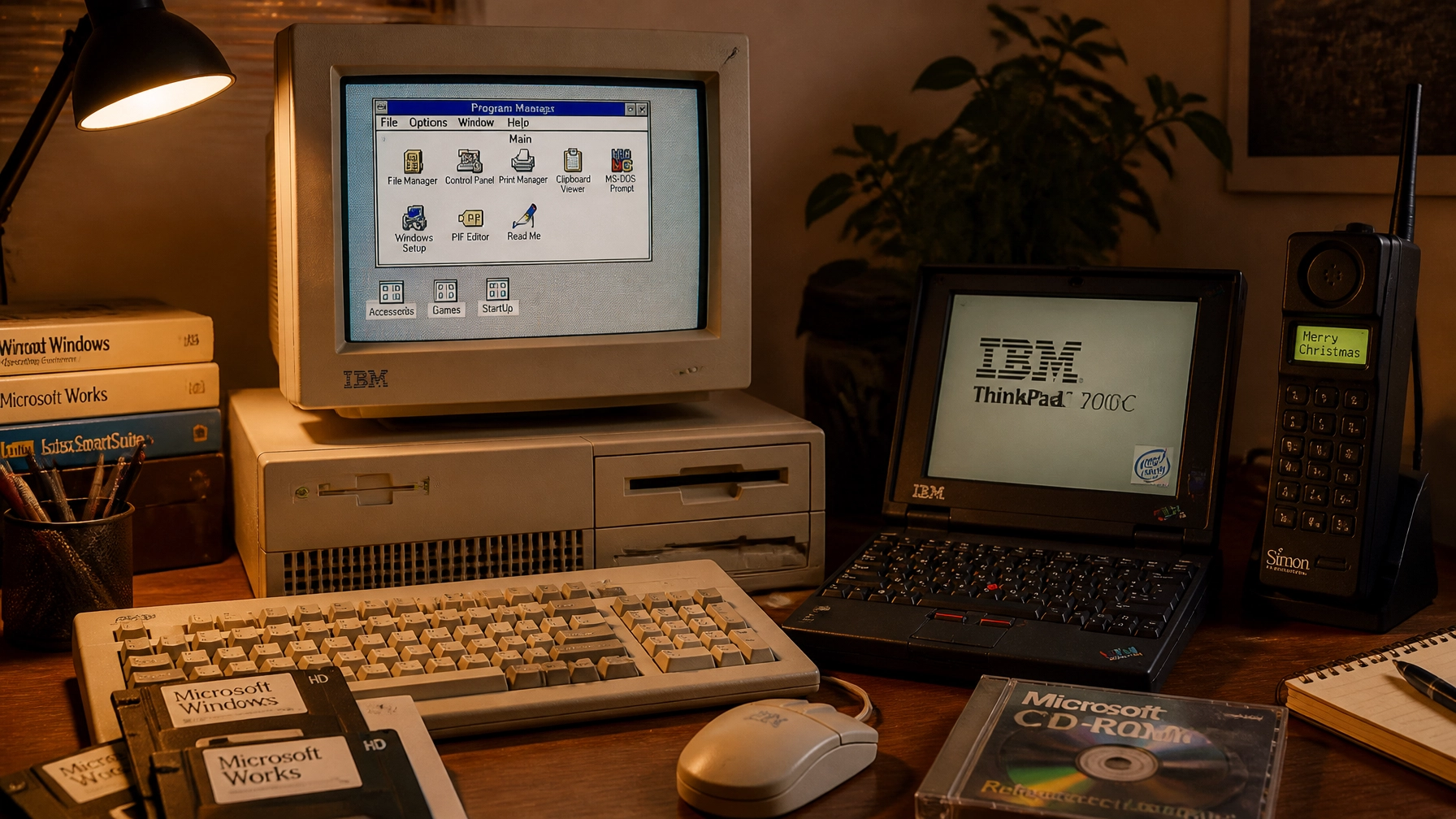
Welcome back to the second instalment of our weekly journey through the digital ages. Last week, we explored the foundations of the World Wide Web in our look at Year by Year, Tech History, 1991 – The Year the Web Began. As we move into 1992, the atmosphere in the tech world was shifting. Computing was no longer just a hobby for the dedicated enthusiast; it was becoming an essential tool for the modern office and a burgeoning presence in the British home.
If 1991 was about the birth of the web, 1992 was the year the PC truly grew up. It was a year defined by refined interfaces, the birth of mobile messaging, and the arrival of hardware that would set the standard for decades to come. At ABC Service, we often look back at these milestones to appreciate just how far the IT support and computer repairs industry has evolved.
Windows 3.1 – The GUI goes mainstream
In April 1992, Microsoft released Windows 3.1, and the world of desktop computing changed almost overnight. While Windows 3.0 had laid the groundwork, 3.1 was the version that made the Graphical User Interface (GUI) feel "ready" for everyone. It sold over one million copies in its first two months alone, a staggering figure for the time.
Windows 3.1 introduced several features that we now take for granted:
- TrueType Fonts: For the first time, Windows offered scalable fonts that looked the same on the screen as they did when printed. This was a massive leap forward for businesses using our printing services, as it meant "What You See Is What You Get" (WYSIWYG) finally became a reality.
- The Program Manager: This was the primary hub for launching applications, providing a structured, icon-based way to navigate your computer.
- Multimedia Support: Windows 3.1 brought built-in support for sound cards and MIDI, turning the silent beige box into a multimedia machine.
- Drag and Drop: Basic drag-and-drop functionality was introduced, making file management significantly more intuitive.
For many of our clients in Devon and Cornwall, Windows 3.1 was their first introduction to a mouse and a desktop. It replaced the intimidating C:> prompt with friendly icons, making the PC an accessible tool for growing businesses and families alike.
The IBM ThinkPad 700C – A design icon is born
In October 1992, IBM launched a machine that would define professional mobile computing for the next thirty years: the ThinkPad 700C. Designed by Richard Sapper and inspired by a traditional Japanese bento box, its stark black, angular aesthetic was a bold departure from the "putty" grey laptops of the era.

The 700C featured a stunning 10.4-inch colour TFT display: the largest of its kind at the time: and the now-famous red TrackPoint nub. This tiny joystick allowed users to control the cursor without needing a separate mouse, making it the perfect tool for the "road warrior" business professional.
We often see vintage tech enthusiasts bringing these machines in for a bit of nostalgia-fuelled care, and it is a testament to IBM’s engineering that many of these iconic devices still power on today. The ThinkPad 700C didn't just provide a way to work on the go; it established the laptop as a serious business tool, a tradition we continue to support through our local business IT services.
"Merry Christmas" – The first SMS text message
Communication took a giant leap forward on 3 December 1992, though few people realised it at the time. Neil Papworth, a 22-year-old test engineer, sent the very first Short Message Service (SMS) text message from a personal computer to a colleague’s mobile phone (an Orbitel 901) on the Vodafone UK network.
The message simply read: "Merry Christmas".
Because mobile phones of the day didn't yet have keyboards, it was a one-way communication from a PC to a handset. It would take a few more years for the world to catch on to "texting," but the seed of the mobile communication revolution was firmly planted on British soil. Today, whether we are setting up VoIP phone systems or managing office WiFi, we owe a lot to that first simple greeting.
The birth of the JPEG and the rise of digital standards
1992 was also a pivotal year for how we handle media. The JPEG (Joint Photographic Experts Group) image standard was finalised, introducing a way to compress digital photos without losing too much visual quality.
Before JPEG, sharing high-quality images was a nightmare for storage and bandwidth. This standard paved the way for the digital photography revolution and remains the backbone of the web today. If you’ve ever sent us a logo for graphic design or web hosting, you’ve likely used a JPEG.
Alongside this, 1992 saw:
- Apple QuickTime: This software gained significant traction, allowing PCs to play video and audio clips: a true "wow" factor in the early 90s.
- CD-ROM Drives: Once an expensive luxury, CD-ROM drives became increasingly common in home PCs. This allowed for massive "multimedia" encyclopaedias like Microsoft Encarta, which felt like magic compared to the stack of floppy disks they replaced.
Linux and the open-source movement
For the more technically minded, 1992 brought a monumental shift in software freedom. Linus Torvalds released the Linux kernel under the GNU General Public License (GPL). This turned Linux into "free software" in every sense, allowing developers around the world to collaborate, modify, and improve the code.
This move was the catalyst for the modern open-source movement. Today, the majority of the world’s web servers and cloud infrastructure run on Linux. It is a fantastic example of what can be achieved when a global community works together: a value we hold dear as a local business supporting our own community in Tavistock and beyond.
Wolfenstein 3D – The First-Person Revolution
It wasn't all spreadsheets and networking in 1992. In May, id Software released Wolfenstein 3D. While not the first 3D game, it was the one that popularised the "first-person shooter" (FPS) genre. Its fast-paced action and smooth pseudo-3D graphics were a revelation.

Gaming has always been a primary driver of PC hardware innovation. The need for faster processors and better graphics cards to run games like Wolfenstein 3D eventually trickled down into more powerful machines for business use. Even today, many of the computer repairs we handle are for gaming enthusiasts looking to squeeze every last drop of performance out of their rigs.
SuperJANET and the UK’s academic backbone
In the UK, 1992 saw the launch of SuperJANET. This was a massive upgrade to the Joint Academic Network (JANET), providing a high-speed fibre-optic backbone for British universities and research centres.
SuperJANET allowed for high-bandwidth applications like early video conferencing and massive data transfers between academic institutions. It ensured that the UK remained at the forefront of internet research, providing the infrastructure that would eventually evolve into the high-speed broadband we all rely on today for our homes and offices.

1992 – A year of maturity
Looking back, 1992 was the year that technology started to feel "solid." We saw the introduction of the term "PDA" (Personal Digital Assistant) by Apple’s John Sculley, and the introduction of the DEC Alpha, a 64-bit processor that hinted at the massive computing power of the future.
"The PC is no longer a gadget; it is the fundamental tool of the information age." – A sentiment echoed across many tech journals in late 1992.
Key takeaways from 1992:
- Accessibility: Windows 3.1 made the PC friendly for the average user.
- Portability: The ThinkPad 700C set the standard for professional laptops.
- Connectivity: The first SMS and the launch of SuperJANET laid the groundwork for our connected world.
- Standards: JPEG and CD-ROMs made multimedia practical for everyone.
At ABC Service, we take pride in being your local experts who understand this history. Whether you are a growing business needing managed IT support or a home user looking for a reliable repair, we bring decades of perspective to every job we do. We believe in providing honest, first-class service that helps our community in Devon and Cornwall thrive in an ever-changing tech landscape.
Next week in our Year by Year series, we dive into 1993: the year the Pentium processor arrived, the Mosaic browser made the web visual, and "Doom" changed gaming forever. See you then!