
If you need printed information to unfold in a clear sequence, accordion fold leaflet printing gives you a practical way to guide readers from one panel to the next.
An accordion-fold leaflet is printed on a flat A5, A4 or A3 sheet. The sheet is then folded in alternating directions to create a concertina or accordion opening. Rather than opening once across a single centre fold, it opens back and forth through multiple connected panels.
The paper size always refers to the flat, unfolded sheet. The number and width of visible panels depend on the selected paper size and fold arrangement, so check the live product instructions before preparing artwork.
You can explore the full specification and place an order on our accordion fold leaflet printing product page.
What an accordion-fold leaflet is
Accordion-fold leaflets are made by creating a series of alternating folds across one printed sheet. Each fold changes direction, producing the familiar concertina shape.
When opened, the leaflet can provide a connected reading journey. Each panel can introduce the next part of a message, explain a stage in a process or present a separate section of information.
The key feature is the repeated back-and-forth opening across the sheet.
This makes an accordion leaflet different from several other folded formats:
- A single-fold leaflet opens across one central fold to create two main panels.
- A double-fold leaflet uses two folds and a different panel arrangement.
- A C fold rolls the panels inwards in a barrel-like sequence.
- A Z fold uses a specific zig-zag arrangement and should be treated as a separate product configuration.
- A gatefold brings outer panels in towards a central opening.
Accordion and concertina leaflets should therefore be planned as their own format. The panel sequence, opening direction and fold positions all need checking before design begins.
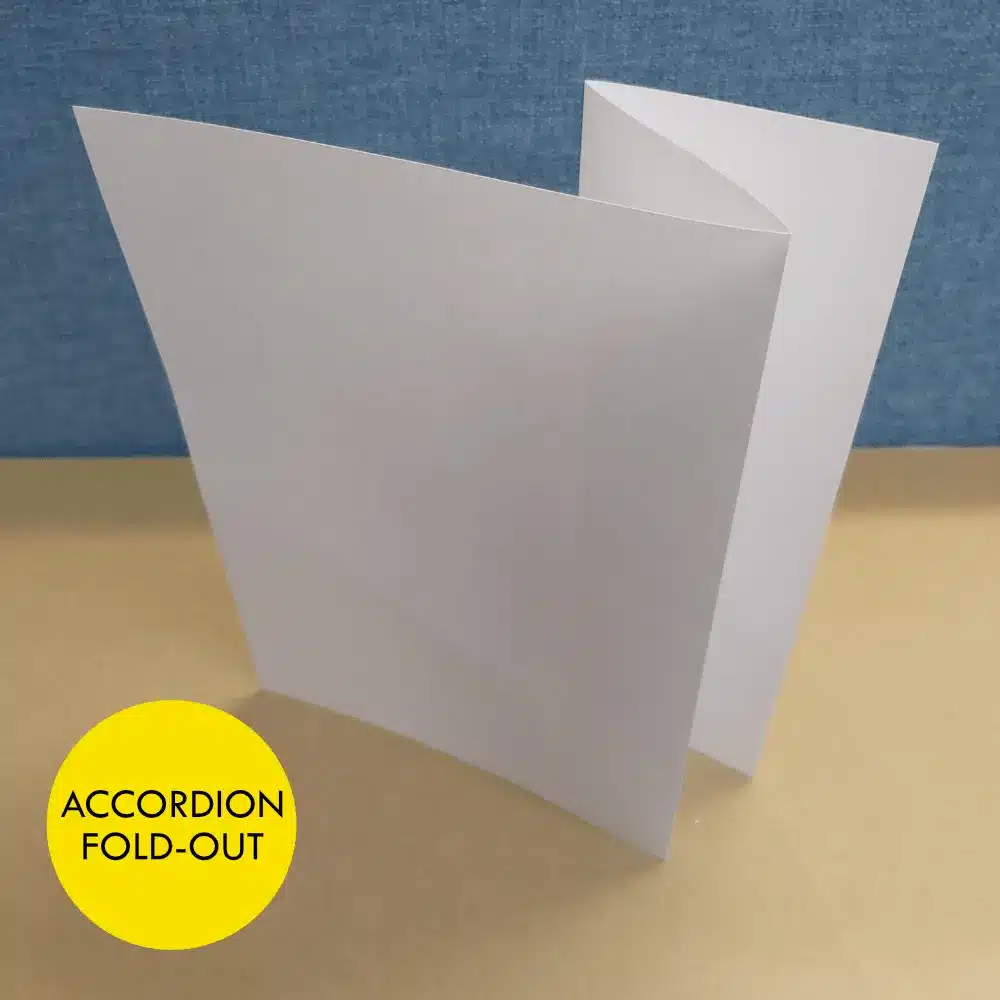
How the concertina arrangement works
The live product offers three flat paper sizes:
- A5, measuring 148 × 210mm
- A4, measuring 210 × 297mm
- A3, measuring 297 × 420mm
The selected sheet is printed and then folded into alternating panels. The final folded size will be smaller than the original flat size, but it cannot be confirmed without knowing the selected fold arrangement.
This is important when planning content. You should not design to an assumed universal panel count or finished size. Instead:
- Choose the required flat paper size.
- Check the live fold instructions and configuration.
- Confirm the panel sequence and opening direction.
- Prepare artwork to the correct flat dimensions.
- Test the fold using a blank sheet before submitting the final file.
A concertina format works particularly well when the reader needs to move through information in order. For example, the first panel can provide an introduction, the next can explain the background, and later panels can present options, evidence, actions and contact information.
When accordion leaflet printing is useful
Accordion leaflets are especially useful when information has a natural sequence or needs more space than a standard flyer can provide.
Common applications include:
- Service and information brochures
- Product ranges and feature guides
- Property information
- Travel information and route summaries
- Event programmes
- Exhibition handouts
- Fundraising campaigns
- Community information projects
- Educational handouts
- Project timelines
- Maps and location-based information
- Sequential storytelling
- Campaign guides and awareness materials
For businesses, an accordion leaflet can help separate complex information into manageable sections. A professional services organisation could use one to explain its process from initial enquiry through to delivery. A manufacturer could use the panels to introduce a product range, compare features and provide ordering information.
For charities, schools and community organisations, the format can support a campaign message without forcing every detail onto one crowded page.
The most effective accordion leaflets give every panel a clear purpose. They do not simply divide a large amount of text into smaller spaces.
Planning the reader journey
Before opening your design software, write down the order in which someone should read the leaflet.
A useful structure might include:
- Opening panel – the main message or introduction
- Background panel – why the subject matters
- Information panels – key facts, services or stages
- Detail panels – supporting evidence, examples or explanations
- Action panel – what the reader should do next
- Contact panel – website, email, telephone number or QR code
The exact sequence will depend on the project. Some leaflets are designed to be read from one end to the other. Others are intended to be opened at different points, with each panel working independently.
Use headings, numbering, arrows and consistent visual cues to make the direction clear. Keep important information away from fold lines, especially:
- Headings
- Logos
- Telephone numbers
- QR codes
- Important diagrams
- Faces in photography
- Small text
- Fine borders
Folds can have minor production tolerances. Allowing space around key content helps the finished leaflet remain readable and balanced.
Choosing paper and finishes
The live accordion leaflet configuration includes a broad range of media:
- 130gsm Silk
- 150gsm Silk
- 250gsm Silk
- 350gsm Silk
- 120gsm Uncoated
- 300gsm Uncoated
- 140gsm Gesso
- 300gsm Gesso
- 400gsm Artboard
- 280gsm Kraft
- Waterproof 260gsm, 195 micron
- Waterproof 365gsm, 270 micron
GSM means grams per square metre. It describes the weight of the paper. In simple terms, a higher gsm usually means a heavier and more substantial sheet.
Micron describes the thickness of a material. A higher micron figure generally indicates a more rigid waterproof material.
The best choice depends on how the leaflet will be used:
- Silk can provide a smooth, professional surface for colour, photography and general business information.
- Uncoated stock has a more natural feel and can be easier to write on.
- Gesso offers a textured finish.
- Artboard provides a more substantial feel.
- Kraft creates a natural, distinctive appearance.
- Waterproof media is useful where the leaflet may face moisture or more demanding handling.
The available finishes are:
- No Laminate – the printed stock remains unlaminated.
- Matt Laminate – reduces reflection and gives a subdued finish.
- Gloss Laminate – adds shine and can make colours appear more vibrant.
- Soft Touch Laminate – creates a smooth, velvety surface.
The live configuration should always be checked because media and finish availability can depend on the selected paper size, fold option and production requirements.
“A good accordion leaflet does not merely hold more information. It gives that information a direction.”
Artwork preparation for accordion leaflets
Artwork requires 3mm bleed on every outer edge. Bleed is the extra background artwork that extends beyond the finished trim area. It allows for small cutting variations and helps prevent unwanted white edges.
The correct artwork size is based on the selected flat A5, A4 or A3 sheet, plus the required bleed. Do not use one universal accordion template for every order.
Before submitting artwork:
- Confirm whether the selected sheet is A5, A4 or A3.
- Check the live product instructions for the selected configuration.
- Set up the document at the correct flat size.
- Add 3mm bleed to every outer edge.
- Mark or confirm the fold positions accurately.
- Keep important content clear of fold lines.
- Check that background colours and images extend through the bleed.
- Confirm the reading order on both sides.
- Export a high-quality print-ready PDF.
- Review the PDF at 100% before uploading.
A simple physical mock-up is one of the most useful checks. Take a blank sheet at the same proportions as the selected format and fold it back and forth. Number each panel and write a short note about the content intended for that position.
Then open the mock-up in the same direction as the finished leaflet. This will help identify reversed panels, incorrect page order and content that has been placed on the wrong side.
Folded or flat delivery
The product description explains that the leaflet is printed on both sides. The live configuration also includes a Folded or Flat choice rather than a separate single-sided or double-sided selector.
The live instructions state that:
- 130gsm Silk, 150gsm Silk, 120gsm Uncoated and 140gsm Gesso are supplied folded.
- Other media are supplied flat but creased for easy folding.
Because the available option can depend on the selected media and configuration, check the live product instructions before ordering. This is particularly important if your team needs the finished leaflets folded for immediate distribution or prefers to complete the folding in-house.
Quantities and turnaround options
The product configuration supports quantities from 1 to 10,000. This makes the format suitable for a small local information project as well as a larger national campaign.
Despatch and collection options shown on the live product page include:
- 3–5 working days
- 2 working days
- 1 working day
The available timing and final cost depend on the selected size, media, laminate, quantity, fold or flat option and delivery requirements. We recommend checking the live configuration rather than relying on a standard price or assumed turnaround.
Design support and production in Tavistock
You can supply print-ready artwork or use our graphic design service if you need help with the layout, panel sequence or visual presentation.
Accordion layouts need careful planning because the design must work both as a flat sheet and as a folded item. Our team can help check whether the artwork is set up for the selected format before production.
ABC Service produces print work in-house at 69 West Street, Tavistock, Devon. Local customers can arrange collection, while our printing service supports businesses and organisations across the UK.
You can also explore our wider leaflet printing range if another fold is more suitable. The single-fold leaflet may suit a simple two-panel message, while double-fold, C-fold, Z-fold and gatefold products provide different panel arrangements.
Summary and Takeaway
Accordion fold leaflet printing is a flexible option for organisations that need to present information as a connected sequence.
The leaflet is printed on a flat A5, A4 or A3 sheet and folded in alternating directions to create a concertina opening. The paper size refers to the flat sheet, not the final folded item. Panel count, panel width and folding arrangements should always be confirmed against the live product instructions.
For a reliable result:
- Plan the reading journey before designing.
- Use the selected flat size plus 3mm bleed.
- Keep important content clear of fold lines.
- Test the opening direction with a blank mock-up.
- Choose media and laminate according to the intended use.
- Check whether the selected option is supplied folded or flat but creased.
- Review the live product configuration before submitting artwork.
When the information has a natural order, an accordion leaflet can turn a large amount of content into a clear, compact and engaging reader journey.