
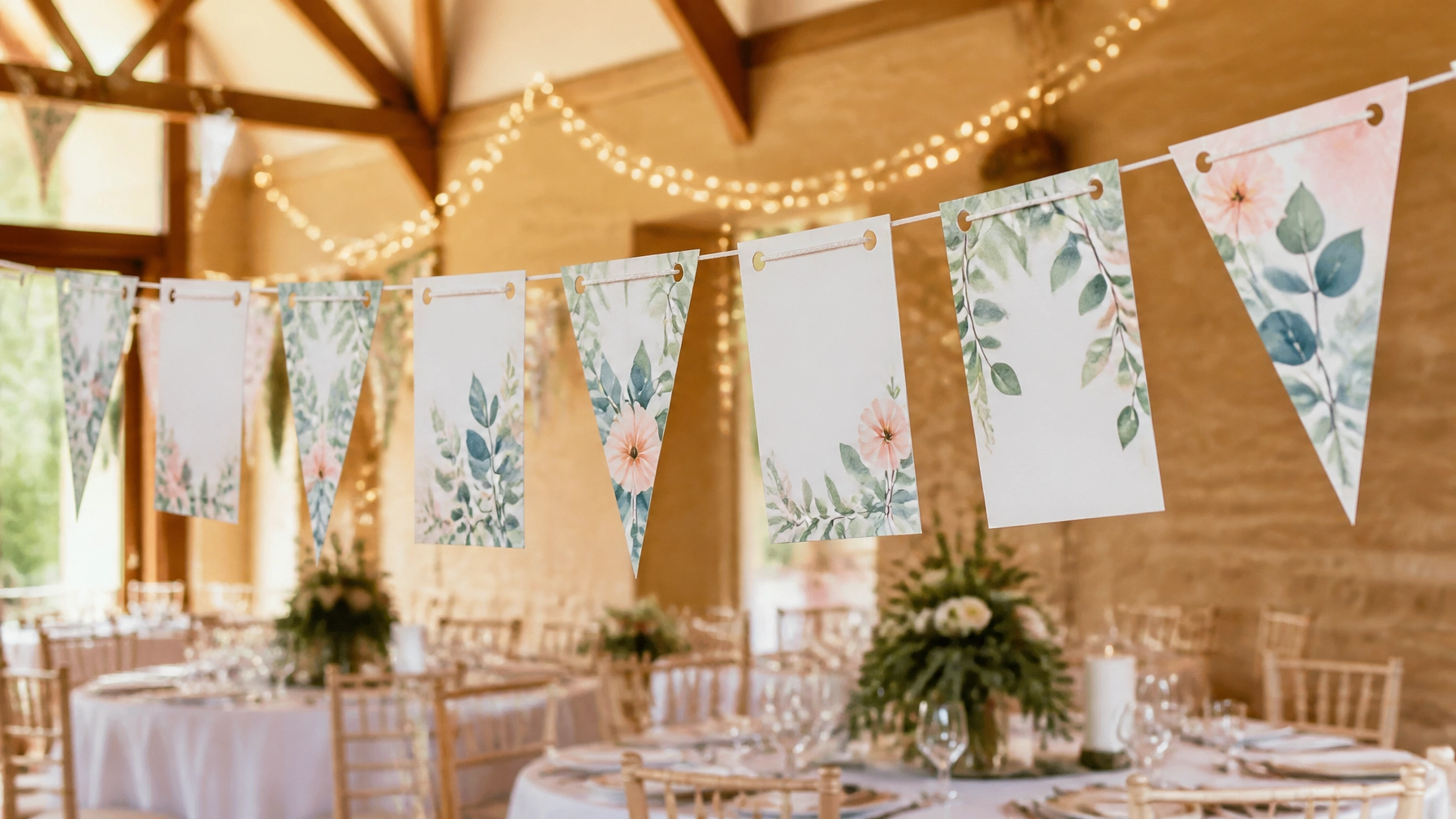
Printed string bunting is a simple way to add colour, direction and personality to a wedding, party, fundraiser or business event. It works by threading individual printed flags onto the supplied string through pre-drilled holes, then hanging the finished length between suitable fixing points.
The amount you need depends on the number and length of your planned runs. ABC Service’s A5 String Bunting provides six pieces per metre, with a minimum order of 3 metres. That means a 3-metre order contains 18 printed pieces.
You can choose triangular or rectangular flags, single- or double-sided printing, and either 350gsm Silk or Waterproof 260gsm media. The customer assembles the bunting using the supplied string.
How printed string bunting works
The process is straightforward.
- Measure the areas where the bunting will hang.
- Decide whether triangular or rectangular flags suit the design.
- Prepare artwork with 3mm bleed.
- Choose single- or double-sided printing.
- Order the required number of metres.
- Thread the supplied string through the pre-drilled holes.
- Hang the completed bunting using appropriate fixings.
Each metre contains six pieces. This makes the quantity easy to plan, particularly when you already know the length of a wall, table frontage, marquee edge or outdoor display.
The bunting is supplied ready for you to assemble, rather than arriving as one permanently fixed display. This gives you flexibility when deciding the spacing, direction and final arrangement at the venue.

“A good event display does not need to be complicated. Clear planning, consistent colour and the right amount of print can make the whole setting feel considered.”
How much personalised bunting do you need
Start by listing every area where you want to use the bunting. Common examples include:
- Across a room between two walls
- Along the front of a top table
- Around a cake, gift or registration table
- Across a marquee, tipi or outdoor seating area
- Around an entrance or welcome point
- Behind a presentation, photo area or dessert table
- Along the edge of a stall or exhibition display
Measure each run in metres. Then add a little extra for the curve created when the string hangs between two fixing points. You may also want additional string at either end for tying or securing the bunting.
A simple planning method is:
Measured display length + allowance for drape and fixing = total order length
For example, if you want to decorate a 4-metre wall, ordering exactly 4 metres may leave little room for a gentle curve or tying the ends. Allowing a little extra gives you more flexibility. Round your total up to the next whole metre, remembering that the minimum order is 3 metres.
A simple flag calculation
Because each metre contains six pieces:
- 3 metres provides 18 pieces
- 4 metres provides 24 pieces
- 5 metres provides 30 pieces
- 6 metres provides 36 pieces
If you are decorating several separate areas, calculate each run individually. This helps you avoid using too much bunting on one display and finding that another area has not been covered.
The right amount also depends on the look you want. A widely spaced display can feel light and informal, while several shorter runs can create a fuller backdrop around a table or entrance.

Choosing between triangular and rectangular flags
The product page offers a choice between triangular and rectangular bunting. Both are useful, but they create different visual results.
Triangular flags for traditional event styling
Triangular flags are the familiar bunting shape. They work particularly well for:
- Country-style weddings
- Garden parties
- School fairs and community events
- Village fêtes and fundraising days
- Children’s parties
- Informal outdoor celebrations
The triangular artwork area is approximately 148 × 210mm. The pointed shape naturally draws the eye downwards and creates movement when the string is hung in a gentle curve.
Simple patterns, alternating colours and short words can work well on triangles. If you are using lettering, keep the text comfortably inside the finished flag area and avoid placing important details too close to the edges.
Rectangular flags for logos, photographs and clear layouts
Rectangular flags are A5 size at 148 × 210mm. Their straight edges provide a more predictable canvas for:
- Business logos
- Sponsor details
- Event names
- Photographs
- Repeating brand patterns
- Modern, minimalist designs
- Larger areas of colour or information
Rectangular flags can be particularly useful for corporate events, product launches, exhibitions and branded hospitality areas. They can also suit weddings where the design includes photographs, initials or a more structured visual layout.

Artwork preparation for bunting printing
Good artwork preparation helps the finished flags look clean and balanced.
The product requires 3mm bleed on the artwork. Bleed is the extra area that extends beyond the intended cut line. It allows the background colour or design to run fully to the edge after trimming.
When preparing your files:
- Extend background colours and patterns into the 3mm bleed area.
- Keep logos, names and important details away from the trim edge.
- Use high-resolution images where photographs are included.
- Check that the artwork matches the chosen triangular or rectangular shape.
- Confirm the order of colours or designs before sending the files.
- Check whether single- or double-sided printing is more suitable.
You can supply colours and specify the order in which they should appear. You can also provide colours and a logo without a background for a more bespoke design. This gives you control over how the finished bunting supports your event theme or brand.
If you need artwork preparing, our graphic design service may be useful. Design work is separate from the printed product, so it is sensible to confirm what artwork you have available before placing an order.

Single-sided or double-sided printed bunting
Single-sided printing places the design on one side of each flag. This is often suitable when the back of the bunting will face a wall, backdrop or other surface that will not be viewed.
Double-sided printing places artwork on both sides. It can be helpful when the bunting hangs across an open room, between outdoor posts or in a space where guests will see both faces of the flags.
Before choosing, consider:
- Whether people will walk around both sides
- Whether the bunting will hang across a room
- Whether the reverse side will be visible in photographs
- Whether both sides need the same design
- Whether the display is being used for wayfinding or branding
For double-sided artwork, check the orientation carefully. A design that looks correct from one direction may appear upside down from the other if the layout has not been planned properly.
Choosing the right media
ABC Service offers two listed media options for this product:
- 350gsm Silk
- Waterproof 260gsm, 195 micron
The choice should reflect the setting and how the bunting will be handled. For an indoor wedding or party, consider the appearance and rigidity of the chosen media. For an outdoor display, waterproof media may be a more appropriate option, subject to the conditions and fixing method at the venue.
The product page does not include an automatic finish beyond the selected media. If you are unsure which option fits your display, check the conditions where the bunting will be used before ordering.

Assembling and hanging the bunting
Once your order arrives, the flags have pre-drilled holes in the top corners and the string is supplied.
Assembly involves:
- Lay the flags out in the intended order.
- Check the printed sides and sequence.
- Thread the string through the pre-drilled holes.
- Keep the spacing consistent where possible.
- Leave enough string at both ends for fixing.
- Test the finished length before hanging it at the venue.
Use fixings that suit the surface and location. Indoor displays may use suitable hooks or removable fixing products, while outdoor displays need more careful consideration of wind, moisture and the strength of the attachment points.
Do not rely on the bunting string alone to support unsuitable loads. The flags are for decoration and display, so choose a safe hanging position away from walkways, hot equipment and areas where people could catch on the string.


Where to order printed string bunting
ABC Service prints in-house in Tavistock, Devon, supporting local customers with friendly assistance and delivering print products across the UK. That combination is useful when you need a local point of contact but your event, venue or organisation is elsewhere.
You can view the full specifications and order the A5 String Bunting directly from the product page.
For other event materials, including flyers, posters and display products, visit our printing services page. We work with homes, SMEs, charities, schools, event organisers and larger organisations that need practical, professionally printed materials.
A practical personalised bunting checklist
Before placing your order, check the following:
- Measure every display run.
- Add allowance for drape and fixing.
- Remember that each metre contains six pieces.
- Meet the 3-metre minimum order.
- Choose triangular or rectangular flags.
- Confirm whether single- or double-sided printing is needed.
- Choose 350gsm Silk or Waterproof 260gsm, 195 micron.
- Prepare artwork with 3mm bleed.
- Keep important text and logos away from the trim edge.
- Supply colours and their order if using a repeating pattern.
- Provide a logo without a background if it is part of the design.
- Allow time for self-assembly.
- Choose suitable, secure fixing points at the venue.

The main takeaway
Printed string bunting is easiest to plan when you start with the display length, flag shape and artwork requirements. With six pieces per metre, supplied string and pre-drilled holes, the assembly is simple once the flags arrive.
Triangular flags suit traditional and playful event styling, while rectangular A5 flags provide a structured area for logos, photographs and clear designs. Select the media and single- or double-sided option according to where the bunting will be displayed, then prepare the artwork with the required 3mm bleed.
For locally printed personalised bunting from Tavistock with UK-wide delivery, you can explore the A5 String Bunting product page.