
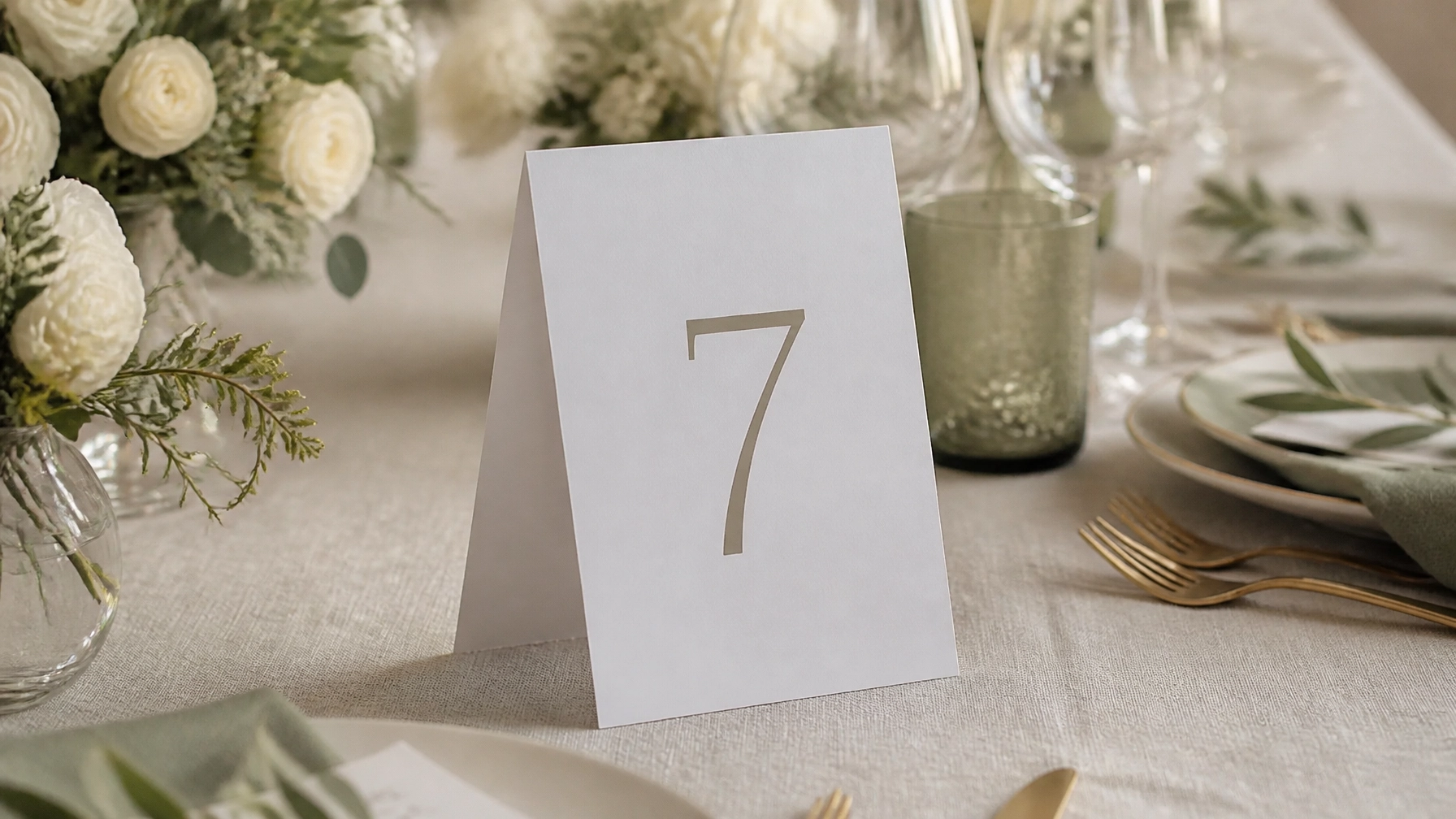
Wedding table numbers help guests find their seats quickly and give your reception layout a clear visual structure. The best choice depends on your venue, table spacing, decoration and wider stationery design.
For many receptions, a folded A5 tent card is a practical option. It is large enough to read across a table, stands without a separate holder and presents the number on both visible sides. The fold also gives the card useful rigidity, making it well suited to centrepieces and reception tables.
Here is what to consider when choosing wedding table numbers, from size and paper stock to artwork preparation and how the cards work with your seating plan.
What wedding table numbers do
A table number is a simple signpost for your guests. It connects the information on your seating plan with the physical tables in the reception room.
For example, your seating plan may tell a guest to find table 7. The corresponding table number then confirms that they have reached the right place.
Clear table number cards can help to:
- Direct guests around the room
- Reduce confusion during the meal
- Support the work of ushers and venue staff
- Keep table arrangements organised
- Continue the visual style established by your invitations
- Make the reception feel considered and complete
“The table number is a small detail, but it has a practical job to do before it becomes part of the decoration.”
Table numbers do not need to carry lots of information. A large, legible number is usually more useful than a crowded design with several decorative elements competing for attention.
Choosing the right size
The ideal size depends on how far away guests need to read the number and how much space is available on each table.
A5 for strong visibility
A5 table numbers offer a useful balance between visibility and practicality. The product is supplied as an A5 table-number tent card, printed and scored down the middle so it folds into its freestanding tent shape. Artwork should be supplied at 154 × 216mm including 3mm bleed, following the product instructions.
A5 is particularly suitable when:
- Tables are spread across a larger reception room
- Centrepieces are moderately tall
- Guests need to identify tables from several metres away
- You want the number to be a clear part of the styling
- You prefer a freestanding card rather than a frame or holder
A smaller card may work well in an intimate venue, but the number still needs to be visible from the opposite side of the table. A larger format may be appropriate for a very spacious venue, although it can take up more room around flowers, candles and place settings.
Think about the whole table setting
Before finalising your size, consider the table itself. Look at the height and width of:
- Floral arrangements
- Candlesticks and lanterns
- Glassware
- Menus
- Place settings
- Table names or other decorative signs
The table number should be easy to spot without blocking conversation or crowding the centre of the table. A folded A5 card can sit neatly among the styling while remaining upright and visible.

Why folded A5 tent cards work well
Folded tent cards are printed and scored down the middle. Once folded, they create two A5 panels joined at the top, allowing the table number to be seen from more than one direction.
This format is useful because it:
- Stands independently on the table
- Does not require an acrylic holder or frame
- Provides double-sided visibility
- Has added stability because of the fold
- Makes efficient use of the table surface
- Can be styled with a simple or more decorative design
The fold should be planned as part of the artwork rather than treated as an afterthought. Position the number and any important design elements so they remain comfortably inside the trim area and away from the score.
A clear, centred number normally works best. If you are using a floral pattern, illustration or border, keep those elements balanced across both panels so the finished card looks intentional from either side.
Preparing artwork correctly
Artwork dimensions are important for table number printing. The product is supplied as an A5 table-number tent card, printed and scored down the middle so it folds into its freestanding tent shape. Artwork should be supplied at 154 × 216mm including 3mm bleed, following the product instructions.
Bleed allows the background colour or artwork to extend beyond the final trim edge. Without it, a small amount of movement during production could leave a thin unprinted edge.
When preparing your file:
- Supply the artwork at 154 × 216mm including the 3mm bleed
- Keep numbers and important design details safely inside the trim area
- Avoid placing fine text directly on the fold
- Check that the number remains upright and correctly positioned
- Use sufficiently strong contrast between the number and background
- Review both sides of the design before sending the file
- Export the final artwork in the file format requested by your printer
If you are unsure about the setup, ask for guidance before production begins. A short artwork check can prevent avoidable corrections later. If you need help creating or adapting your layout, our graphic design service can be considered where appropriate.

Selecting the right card media
The feel and rigidity of the card influence how the table numbers look and behave on the day. The A5 table number product page lists several media options:
- 300gsm uncoated for a natural, straightforward paper feel
- 350gsm silk for a smooth card surface
- 400gsm Artboard for a heavier, more rigid option
- 280gsm Kraft for a warm, natural appearance
- 300gsm Gesso for a textured card feel
The right choice depends on your design and the atmosphere you want to create. Kraft may suit rustic or botanical styling, while a smooth stock can complement a clean, contemporary stationery suite. A textured option may add tactile interest without requiring additional decorative treatments.
The available media are listed on the A5 table numbers product page. Check the current options when ordering, as the chosen stock will affect the look and feel of the finished cards.

Matching table numbers with your wedding stationery
Your table number cards do not need to be identical to every other printed item, but they should feel as though they belong to the same stationery collection.
Consider repeating one or two elements, such as:
- The typeface used for your invitations
- A colour from the seating plan
- A simple botanical, geometric or venue-inspired motif
- The border style used on your menus
- The same illustration or monogram treatment
- Similar spacing and alignment
Table numbers can work alongside:
- A seating plan displayed at the entrance
- Place cards identifying individual seats
- Menus positioned at each place setting
- Welcome boards and ceremony signage
- Orders of service or other wedding stationery
The seating plan gives guests their table information before they sit down. The table number then confirms the destination once they enter the dining area. Place cards provide the final level of detail by showing each guest where to sit.
This layered approach keeps each printed item focused on one job. The seating plan should be easy to scan, the table number should be visible across the room and the place card should identify the individual seat.
Ordering table numbers from a local printer
Wedding stationery often involves several decisions, including artwork, paper stock, quantities and delivery dates. Working with a printing team that can explain the practical details can make the process more straightforward.
At ABC Service, we produce table numbers in-house at our print workshop in Tavistock, Devon. Our local team supports customers in Tavistock and the surrounding area, while UK-wide delivery is available for wedding stationery printing orders.
Our approach is simple:
- Choose the required quantity and card media
- Prepare your artwork to the supplied dimensions
- Check the fold, number placement and trim area
- Submit the artwork with your order
- Allow time for production and delivery before the wedding
It is sensible to order one table number for each table shown on the seating plan, with a small number of spares if your layout may change. Confirm the final table count before production wherever possible.
You can also explore our wider printing services for other printed materials required for your event.

A simple design checklist
Before sending your artwork, check the following:
- Is the table number immediately obvious?
- Can it be read from the opposite side of the table?
- Is the artwork supplied at 154 × 216mm including 3mm bleed?
- Are important details positioned safely inside the final trim area?
- Is the design clear on both visible sides?
- Does the number avoid the centre score?
- Does the card stock suit the wider wedding stationery?
- Have you ordered one card for every table?
- Do you have enough time for production and delivery?
- Have you kept a final approved version of the artwork?
Good wedding table numbers combine visibility, stability and consistency. The most effective design is usually the one guests can understand instantly.
The takeaway
Wedding table numbers are both a practical seating aid and an important part of the reception styling. Choose a size that suits the venue, use a clear and well-spaced number, and select a card media that complements the rest of your stationery.
For many receptions, folded A5 tent cards are a dependable choice because they stand independently, fold into a stable form and offer double-sided visibility. With artwork supplied at 154 × 216mm including 3mm bleed and important details kept safely inside the trim area, they can look polished while helping the day run smoothly.
For locally produced wedding table number cards from Tavistock, Devon, with UK-wide delivery, view the A5 table numbers product page.