
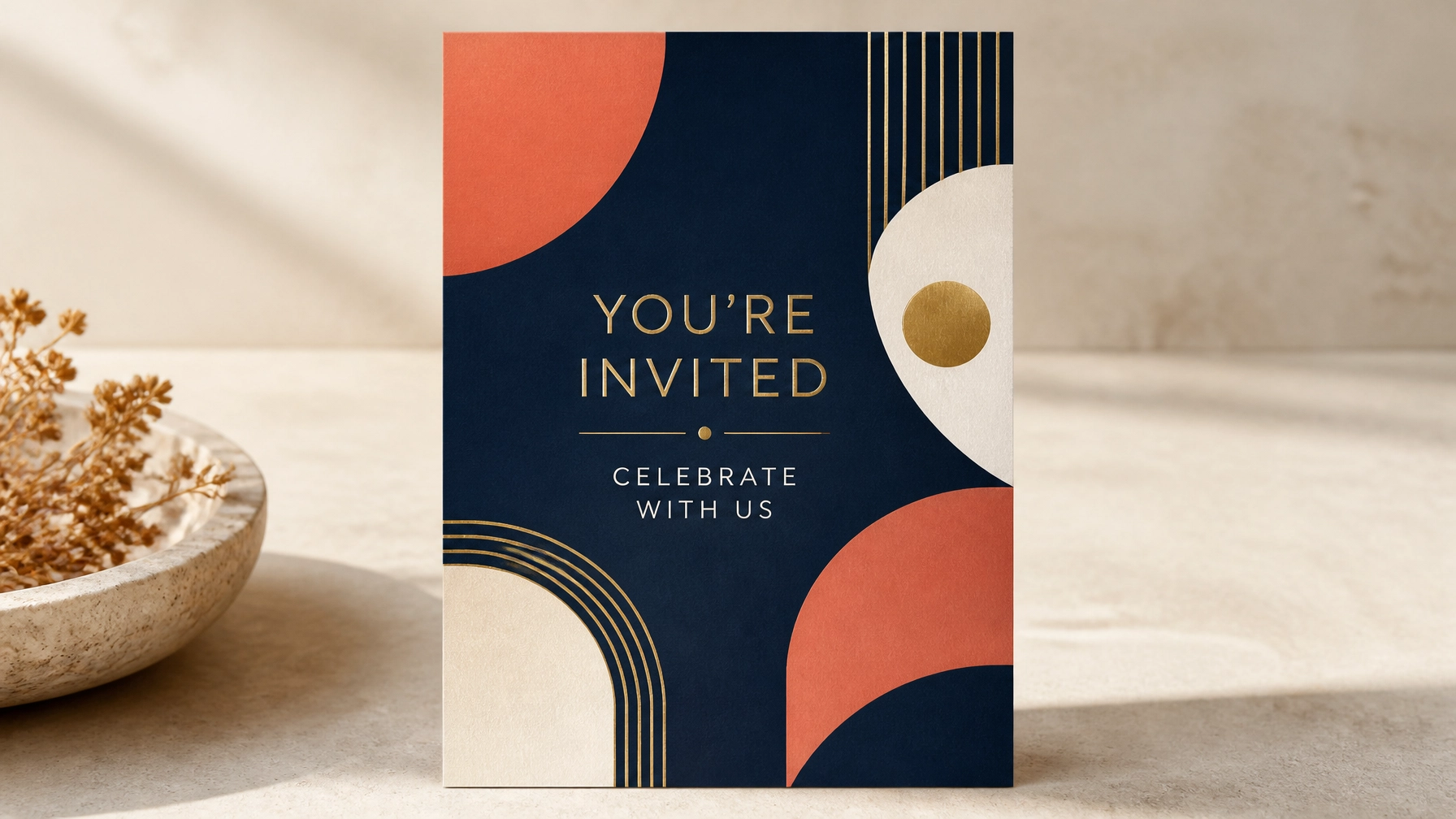
When you need a printed invitation that is easy to handle, display and post, A6 invitation printing offers a practical balance between useful space and compact presentation.
An A6 invitation measures 105 × 148mm when finished. It is a single, flat portrait sheet with enough room for the essential event information, a strong visual design and clear RSVP details. For print production, artwork should be supplied at 111 × 154mm, allowing for a 3mm bleed on every edge.
This guide explains the format, available media, finishing choices and artwork requirements before you order your personalised A6 invitations.
A6 size explained – 105 × 148mm
A6 is a widely recognised paper size. In portrait orientation, it is:
- 105mm wide
- 148mm high
- A single flat printed sheet
- Suitable for envelopes, display boards, event tables and direct posting
The compact dimensions make A6 useful for many occasions. It can carry the event name, date, time, venue, contact details and RSVP instructions without becoming difficult to handle.
A6 works particularly well for:
- A6 wedding invitations
- Birthday celebrations
- Anniversaries
- Engagement parties
- Graduations
- Christenings
- Private family events
- Corporate events and networking occasions
- Business open days
- Charity and community events
Some searches use phrases such as “A6 invitation cards” or “birthday invitation card printing”. On this page, those terms refer to a single flat printed invitation rather than a folded format.
“Good event stationery should make the important information easy to find while giving guests a clear sense of the occasion.”
Why A6 works well for event stationery
A successful invitation needs to do two things. It should communicate practical information clearly, and it should establish the atmosphere of the event.
A6 provides a useful amount of space for both purposes. The front can include a strong design, event title or photograph, while the reverse can hold a schedule, directions, RSVP information or accessibility details when double-sided printing is selected.
The format is also straightforward for recipients. It fits neatly into an A6 envelope, can be placed on a noticeboard or fridge, and is large enough to read comfortably when the typography is planned properly.
For organisations, A6 invitation printing can also create a consistent visual identity across an event range. For example, a business might use one design for an open day, another for a supplier session and a third for a customer information event.
Choosing the right printed media
The live A6 invitation printing product page lists a broad selection of media. The best choice depends on the appearance, durability and handling requirements of your event.
Available options include:
- 130gsm Silk
- 150gsm Silk
- 250gsm Silk
- 350gsm Silk
- 120gsm Uncoated
- 300gsm Uncoated
- 140gsm Gesso
- 300gsm Gesso
- 400gsm Artboard
- 280gsm Kraft
- 770gsm Magnetic
The term gsm means grams per square metre. In simple terms, a higher gsm usually indicates a heavier and more substantial sheet. It is not the only measure of rigidity, but it provides a useful comparison when reviewing media choices.
Silk media offers a smooth finish that suits colourful artwork and photography. Uncoated media has a more natural surface and is often easier to write on. Gesso media provides added texture, while Kraft offers a warm, distinctive appearance. Artboard and magnetic media are specialist options that should be selected with the intended use in mind.
The live ordering system should always be checked for the exact combination of media, finish, quantity and delivery choice available for your order.

Finishing options for A6 invitations
The product page includes several finishing choices:
- No laminate
- Matt Laminate
- Gloss Laminate
- Soft Touch Laminate
Lamination can alter both the appearance and handling of the finished invitation. Matt laminate reduces surface reflection and gives a restrained, contemporary look. Gloss laminate produces a brighter visual finish, particularly with strong colours and photographs. Soft Touch Laminate adds a smooth, tactile surface.
Matt, Gloss and Soft Touch Laminate add production time. The current product options identify the relevant despatch adjustment, so check the live page before confirming your deadline.
You can also choose between:
- Single-sided printing
- Double-sided printing
- No envelopes
- White envelopes
- Kraft envelopes
Not every media and finishing combination should be assumed to be available together. The live product configuration is the best source of the options available at the time of ordering.
Preparing artwork correctly

The finished invitation is 105 × 148mm. Your artwork should be prepared at 111 × 154mm, including 3mm bleed on every edge.
Bleed is the extra area that extends beyond the final cutting line. It allows background colours, patterns and images to run right to the edge after trimming. Without bleed, small variations during cutting can leave an unwanted white line along an edge.
A simple preparation checklist is:
- Set the document to portrait orientation
- Prepare the artwork at 111 × 154mm including bleed
- Extend backgrounds and edge-to-edge images into the 3mm bleed
- Keep essential content inside a safe margin
- Check names, dates and addresses carefully
- Export a high-quality print-ready file
- Review the final proof before production
The safe margin is the area inside the finished 105 × 148mm trim line. Keep important information comfortably away from the edges. This includes:
- Event names
- Dates and times
- Venue addresses
- RSVP information
- Telephone numbers and email addresses
- Accessibility instructions
- Business logos and sponsor details
A 3–5mm internal safe margin is a sensible working guide. Decorative elements can sit closer to the edge, but essential details should remain comfortably inside the trim area.
Planning single-sided and double-sided designs

Single-sided printing is suitable when all information can be arranged clearly on one side. This can work well for a simple birthday invitation, private celebration or small community event.
Double-sided printing provides more flexibility. You could use:
- The front for the main event design
- The reverse for directions and parking information
- The front for the invitation message
- The reverse for an itinerary or schedule
- The front for the event identity
- The reverse for RSVP and contact information
Plan the front and reverse as separate layouts. Check that the correct page orientation is maintained and that text remains readable when the finished invitation is handled.
If your design includes a photograph, illustration or large block of colour, review it at full size rather than relying only on a zoomed-in screen view. Small text that looks acceptable on a monitor may be difficult to read when printed.
Proofing and ordering multiple designs

Proofing is particularly important for invitations because a small error in a date, venue or RSVP address can affect an entire event.
Before uploading, check:
- Spelling of names and locations
- Date and day of the week
- Start and finish times
- Venue address and postcode
- RSVP deadline
- Contact details
- Website addresses and QR codes
- Dietary, access or parking information
- Correct front and reverse artwork
The ordering system cannot detect multi-page documents automatically. If you supply several pages or designs, you must choose the correct quantity for the total printed requirement.
For example, an event may need different versions for guests, speakers and sponsors. Multiple designs can be useful where the live product options allow them, but the quantity must reflect how many of each version you need. If the ordering structure is unclear, it is sensible to check with the team before submitting files.
Design support for personalised invitations
You can provide your own artwork, or our in-house graphic design team can help prepare a design for print.
Design support may be useful when you need:
- A new event identity
- Consistent artwork across several invitation versions
- Help with typography and information hierarchy
- A print-ready layout from an existing idea
- A design adapted for both single- and double-sided printing
The aim is not simply to make an invitation look attractive. Good design helps guests understand what the event is, when it is happening, where it is taking place and how to respond.
Local production with UK-wide delivery
ABC Service produces print work in-house at 69 West Street, Tavistock, Devon. Local customers can arrange collection, while UK-wide delivery is available for organisations and individuals elsewhere in the country.
Our wider invitation printing category includes other invitation formats, while the main printing service provides an overview of our digital and wide-format production services.
This local production model gives customers a practical point of contact while allowing us to support events across the UK. It also means we can discuss artwork, media and timing with a team involved directly in the print process.

Despatch and collection choices
The live product page lists three despatch or collection choices:
- 3–5 working days
- 2 working days
- 1 working day
The selected media, laminate, quantity and artwork requirements can affect the practical production schedule. Lamination also adds time where selected.
For an important event, allow time to:
- Finalise the wording
- Prepare and check artwork
- Upload the correct files
- Review the proof
- Allow for production and delivery
- Check the finished invitations before distributing them
Ordering earlier gives more opportunity to correct an error or reconsider the media choice.
Summary and takeaway
A6 invitation printing produces a flat portrait invitation measuring 105 × 148mm when finished. Artwork should be supplied at 111 × 154mm with 3mm bleed on every edge, while essential information should remain inside a safe margin.
The format suits weddings, birthdays, anniversaries, corporate events, open days and community occasions. You can select from silk, uncoated, textured, Kraft, board and specialist media, together with laminate, double-sided printing and envelope options where available.
For the current choices, upload requirements and despatch options, visit the A6 invitations printing product page.
When planning your next event, which information deserves the clearest space on the invitation : the event experience, or the practical details that help guests attend with confidence?