
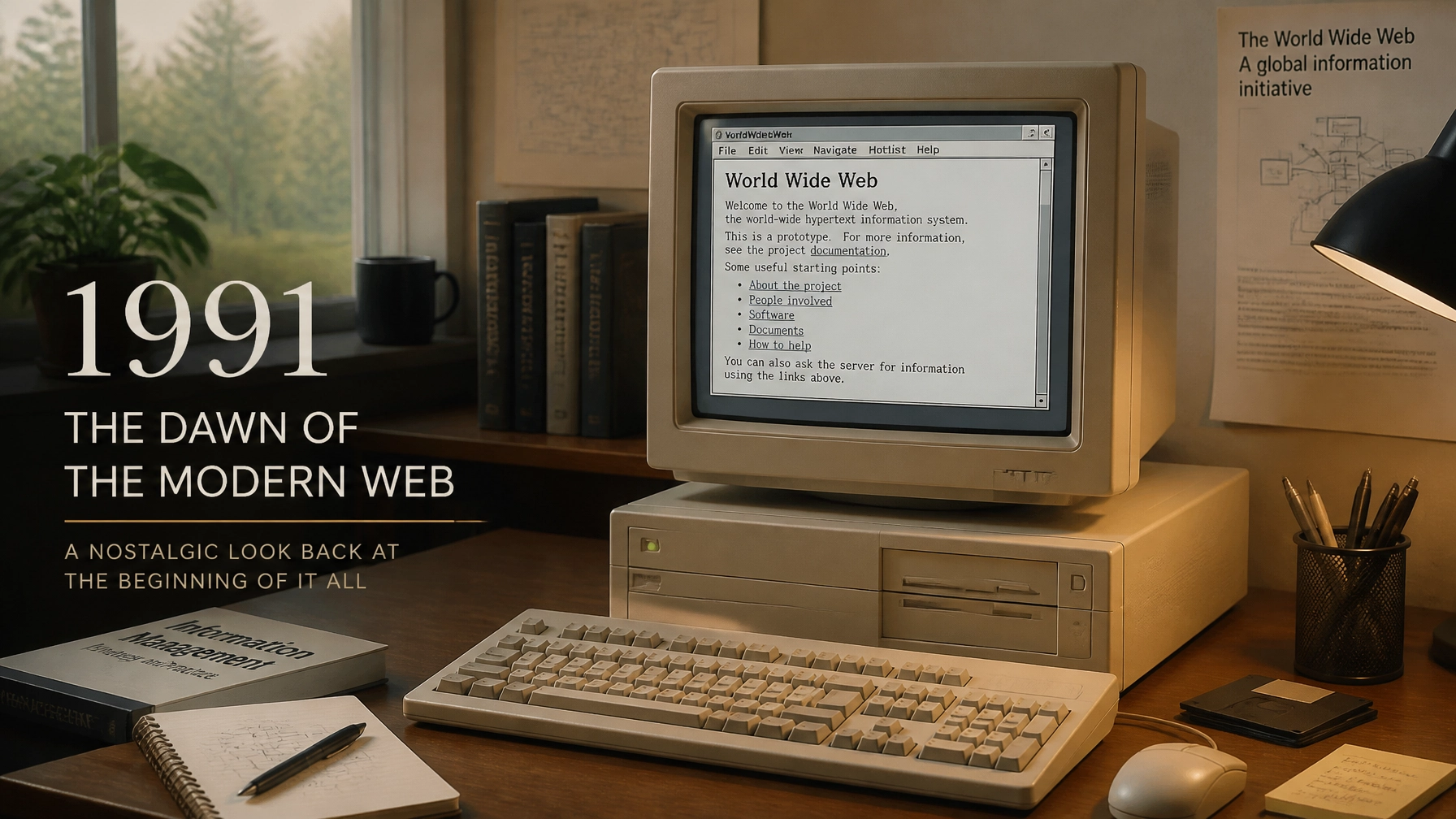
If you want the short answer, 1991 mattered because several building blocks of modern digital life arrived at once. The World Wide Web was opened up beyond CERN, Linux began as a modest but hugely important kernel project, GSM mobile networks reached commercial reality, portable computing became more practical, and media standards such as JPEG and MP3 moved closer to everyday use.
None of this looked flashy at the time. Most of it looked technical, niche or quietly experimental. Yet those developments helped shape how we now browse, work, communicate, listen, play and carry technology with us every day.
This first post in Year by Year, Tech History looks at what changed in 1991, why it mattered then, and why its legacy is still with us now.
Why 1991 is called the dawn of the modern Web
The phrase makes sense for one simple reason. 1991 was the year the Web moved from an internal research tool towards a public-facing system for sharing information.
Tim Berners-Lee’s World Wide Web project began at CERN to help researchers organise and share information more easily. It combined three core ideas that are still familiar today:
- HTML for structuring documents
- HTTP for requesting and delivering them
- URLs for locating them
The first web server ran on a NeXT computer at CERN. Berners-Lee also built the first browser-editor, called WorldWideWeb. By modern standards it was plain, but that was the point. It allowed documents to link to one another in a simple, practical way.
As the original project page put it:
“The WorldWideWeb (W3) is a wide-area hypermedia information retrieval initiative aiming to give universal access to a large universe of documents.”
— CERN, The WorldWideWeb project
On 6 August 1991, Berners-Lee posted details of the project to the alt.hypertext newsgroup, which is widely treated as the moment the Web was opened up beyond CERN. It was still early, technical and limited in reach, but the direction had changed. The Web was no longer just a lab project.
What browsing actually meant in 1991
Browsing in 1991 was a long way from modern web use. A typical experience looked more like this:
- Connect to a workstation or networked computer
- Open a browser that could interpret basic HTML
- Enter or follow a URL
- Request a document from a server
- Read a mostly text-based page and follow links onward
There were no modern search engines, no streaming platforms, and no polished social feeds. The breakthrough was the hyperlink itself. A document could point to another document anywhere on the network, turning information into a connected web rather than a pile of separate files.
The first web server outside CERN was installed at SLAC in December 1991. That may sound like a niche institutional step, but it was an important one. It showed that the Web could spread between organisations rather than remain tied to a single site.
CERN later made the Web available on a royalty-free basis in 1993, which removed a major barrier to wider adoption. Without that decision, the online world might have developed very differently.
You can still view the original World Wide Web project page, and it remains a fantastic reminder that world-changing ideas do not always arrive wrapped in glossy design.
Linux begins, and open collaboration starts to scale
On 25 August 1991, Linus Torvalds posted a message to the comp.os.minix newsgroup explaining that he was building a free operating system for 386 and 486 machines. His wording has become one of the most quoted lines in computing history:
“I’m doing a (free) operating system (just a hobby, won’t be big and professional like GNU).”
— Linus Torvalds, quoted by the Linux Kernel Archives
The first Linux source release, version 0.01, followed in September 1991, with version 0.02 announced in October.
Linux was not a full consumer operating system at that stage. It was a kernel, the core layer that manages memory, hardware access and processes. Even so, its long-term importance is hard to overstate.
Why Linux mattered
Linux showed that software could be built through distributed collaboration over networks and discussion groups. That idea is normal now, but in 1991 it still felt unusual.
Over time, Linux became central to:
- web servers
- hosting infrastructure
- networking hardware
- embedded systems
- supercomputers
- cloud platforms
- Android-based mobile devices
In hindsight, Linux and the Web make a particularly interesting pair. One helped people share information more easily. The other helped power much of the infrastructure that would eventually deliver it.

Hardware and software breakthroughs, the tools people could actually feel
Not every important shift in 1991 happened on a server or in a standards body. Some of it arrived in products people could hold, carry or use at work.
Apple PowerBook 100, portable computing grows up
Apple introduced the PowerBook 100 in October 1991 as part of its new PowerBook line. It used a 16 MHz Motorola 68000 processor and, crucially, adopted a layout that feels familiar even now, with the pointing device positioned below the keyboard.
That sounds ordinary today, but it was a meaningful design step. Portable computers were becoming less awkward and more practical to use.
A machine like the PowerBook made it easier to imagine computing as something that could happen:
- at a meeting table
- on a train
- in a classroom
- between home and work
- away from a fixed desk
It was not an internet-anywhere device, of course. There was no Wi-Fi and no smartphone-style expectation of permanent connectivity. Even so, it helped normalise the idea that serious computing could travel.

Super NES, digital entertainment becomes a bigger cultural force
The Super Nintendo Entertainment System launched in North America in August 1991, following its earlier Japanese debut as the Super Famicom in 1990. Bundled with Super Mario World, it brought richer graphics, stronger audio and more ambitious game design into ordinary living rooms.
The Super NES did not create the Web, but it did help shape public expectations of digital experiences. People were becoming more comfortable with:
- colourful interfaces
- responsive controls
- richer sound design
- immersive digital worlds
- technology as everyday entertainment
That cultural shift matters. The online world did not emerge in isolation. It grew alongside changing expectations about how technology should look, sound and feel.
Visual Basic, software creation becomes more approachable
Microsoft released Visual Basic 1.0 for Windows in May 1991. Its big appeal was practical rather than glamorous. Developers could design a graphical interface visually, placing buttons and text boxes on screen, then connect code to those elements.
That helped push forward rapid application development and made business software creation more approachable for a wider range of developers.
For organisations, that meant internal tools could be built more quickly for tasks such as:
- administration
- stock control
- finance reporting
- data entry
- customer records
The broader story here is accessibility. Progress in tech is not only about raw power. It is also about making useful tools easier to build and use.
Communications and media standards, the connected world starts to form
Another reason 1991 feels so important is that the supporting systems around the Web were also maturing.
GSM, mobile communication goes commercial
On 1 July 1991, Finland’s Radiolinja launched the world’s first commercial GSM network. A widely cited ceremonial call between Harri Holkeri and Kaarina Suonio marked the occasion.
That was a major step because GSM created a shared digital mobile standard with benefits that analogue systems struggled to match:
- better call quality
- improved security
- international roaming potential
- a clearer path to large-scale compatibility
- SIM-based identity rather than tying everything to one handset
The mobile web still lay some years ahead, but GSM provided a foundation for text messaging, mobile data and, eventually, smartphones.
Lithium-ion batteries, portable devices become more realistic
Sony commercialised rechargeable lithium-ion batteries in 1991, initially for products such as camcorders. This may sound less exciting than a new computer or network standard, but it was hugely important.
Lithium-ion batteries offered a strong combination of:
- relatively high energy density
- lower weight than many alternatives
- rechargeability
- better practicality for portable electronics
That chemistry later became central to laptops, mobile phones, digital cameras, tablets and much more. In simple terms, portable technology needed better energy storage just as much as it needed better processors or networks.

JPEG and MP3 groundwork, digital media becomes easier to share
1991 also sits in an important period for digital media standards.
JPEG image compression was under active development as a practical way to reduce photo file sizes, which mattered enormously when storage was expensive and data links were slow. The standard was formally published as ITU-T T.81 in 1992.
MP3, more formally MPEG-1 Audio Layer III, was also taking shape around this period through the wider MPEG-1 standardisation process. The key point is not that everyone was using MP3 in 1991. They were not. The key point is that the groundwork for compressed digital audio was being laid at exactly the right time for the coming online era.
Without formats like JPEG and MP3, the Web would have stayed far more text-heavy for much longer. These standards helped make images and audio practical for real-world use across limited storage and bandwidth.
The global landscape changes, even before most people notice
What makes 1991 fascinating is that its biggest effects were not always obvious at the time. Most households did not suddenly go online. Most organisations did not launch websites overnight. But the direction of travel had clearly changed.
Several big shifts were happening together:
- information was becoming linkable and easier to publish
- software development was becoming more collaborative
- computing was becoming more portable
- mobile communications were moving towards shared standards
- batteries were improving the practicality of untethered devices
- digital media was becoming easier to compress, store and move
- entertainment technology was influencing wider digital expectations
Over the next decade, those threads would transform publishing, retail, music, customer communication, software distribution, education and office life.
Why that still matters now
For businesses and households today, the results are ordinary enough to seem invisible:
- websites are expected
- hosted services are routine
- mobile access is normal
- digital media moves instantly
- connected devices support day-to-day work
That is part of 1991’s legacy. It was not the year everything became modern. It was the year many of the necessary pieces started fitting together.
If you are interested in how those ideas eventually shaped everyday business technology, we cover that practical side in our Computer & IT Support hub and our Web Hosting service pages. The history is different from the day job, of course, but the link is easy to see. The modern web still rests on standards, systems and hardware choices that began taking shape decades ago.
The long-term legacy of 1991
1991 did not create the modern internet in one dramatic moment. It did something more interesting. It brought together several developments that would prove compatible, scalable and surprisingly durable.
Its long-term legacy includes:
- the public-facing beginnings of the Web
- the first steps of Linux as a major open-source force
- commercial GSM as a platform for later mobile connectivity
- better portable computing design
- practical foundations for battery-powered digital life
- compression standards that helped online media become viable
- a broader cultural appetite for digital experiences
The real lesson of 1991 is that major change often arrives in layers. One invention opens access, another improves portability, another supports infrastructure, and another makes media practical. Taken together, they alter the world.
Summary, why 1991 still deserves attention
If someone asks why 1991 matters in tech history, the answer is straightforward. It was the year the modern digital world started to look possible.
The Web moved outwards from CERN. Linux began with remarkable understatement. GSM entered commercial use. Apple refined portable computing. Visual Basic made software development more approachable. Lithium-ion batteries improved the case for mobile devices. JPEG and MP3 groundwork helped prepare the future of online media. Even the Super NES played its part by raising expectations of interactive digital experiences.
The screens were simpler, the speeds were slower and the devices were chunkier, but the trajectory was set.
Next in the series, we move on to 1992, when standards matured further, the Web gained momentum, and more of these early building blocks started becoming practical in everyday life.