
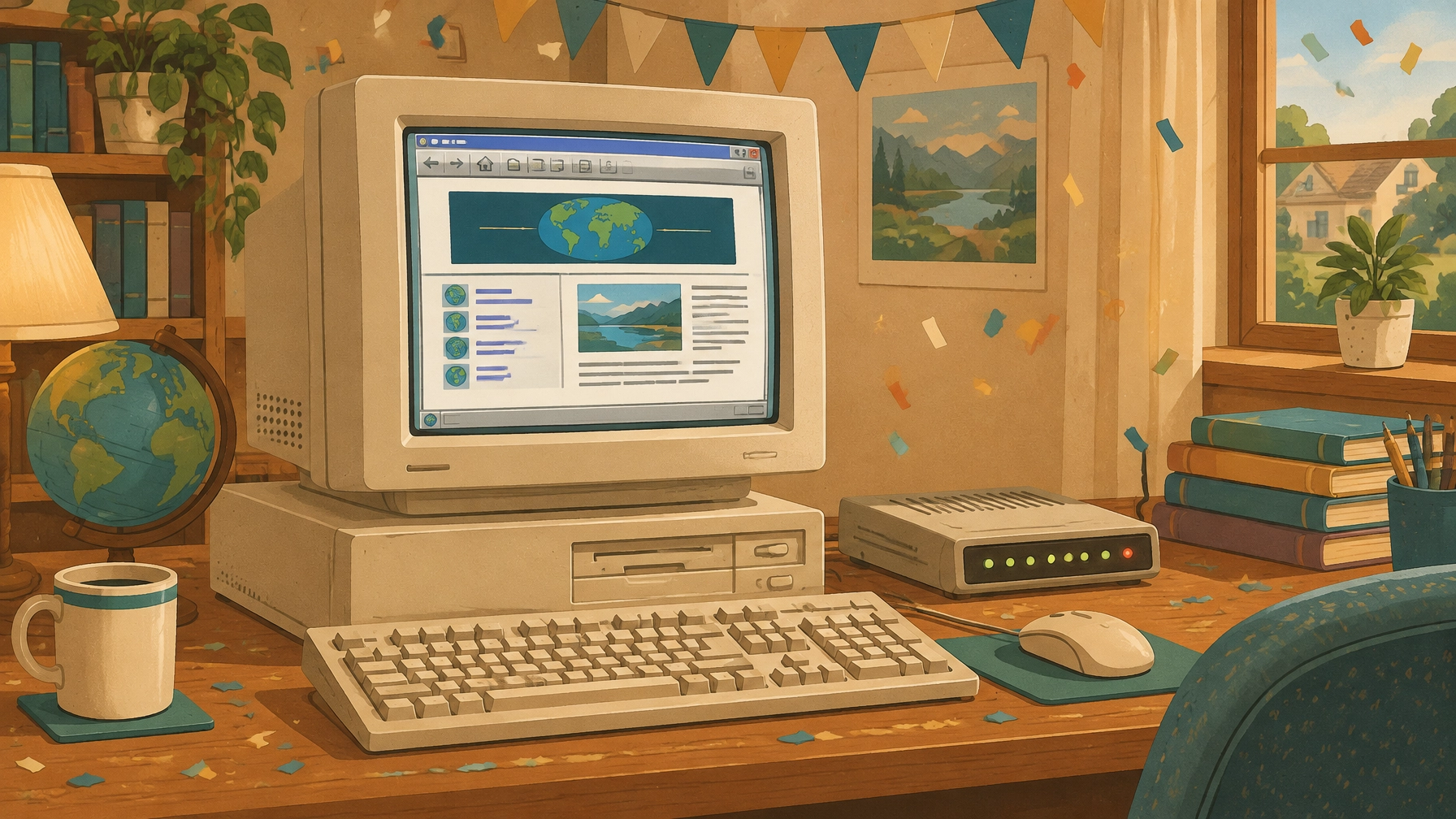
In the previous instalments, we followed the Web from its beginnings into the early days of public access. In 1994, the pace picked up. Browsers became easier to use, websites began to attract advertisers, and more people started connecting from home.
The year’s defining change was not one gadget or launch. It was the shift from the Web as an interesting, largely academic space to a place where companies, publishers and ordinary users could see a practical reason to go online.
A browser made the Web feel closer
In October 1994, Mosaic Communications released a public beta of its new browser, initially called Mosaic Netscape. The team included Marc Andreessen, who had helped create the earlier Mosaic browser, alongside colleagues from the Mosaic project. The company became Netscape Communications in November, and the browser took the name Netscape Navigator.
That naming history is worth a small pause. The October release was technically a beta called Mosaic Netscape 0.9; Navigator 1.0 followed in December. But the browser’s rapid rise made “Netscape” familiar remarkably quickly. It helped make the Web easier to explore, and its popularity gave people a straightforward way to experience the new medium for themselves. The Computer History Museum’s 1994 timeline places Netscape among the year’s defining developments.
The Web still took patience. Pages loaded over dial-up connections, and a busy household might have to negotiate who could use the telephone line. Yet a browser that felt more approachable changed the invitation: people could click through linked pages rather than needing to understand the machinery behind them.
For organisations, that also opened new questions. How would a website be hosted? What information belonged online? Who was the audience? Those questions still matter. Our web hosting services are a present-day answer to the practical side of putting a site online, but the essential idea, making information available to visitors, was taking shape in the mid-1990s.
The banner advert arrives
On 27 October 1994, the online magazine HotWired launched with a group of clickable banner adverts. AT&T’s is the one most often remembered, with its now-famous invitation:
“Have you ever clicked your mouse right HERE? You will.”
It was a neat piece of early internet advertising: small, direct and built around a behaviour that was still new. People were being asked to click an advert and see what happened.
 Several banners appeared together, so it is more accurate to describe AT&T’s as the best-known of the launch adverts than to imagine it appeared alone. Wired revisited HotWired’s first banner ads for their twentieth anniversary.
The format would go on to shape online publishing and marketing. A website could offer useful editorial content while selling space to advertisers. That model helped fund the growing Web, while also beginning a long conversation about attention, privacy and how commercial messages should fit into digital life.
Yahoo starts as a useful list
In April, Stanford students Jerry Yang and David Filo renamed their growing directory of websites Yahoo! The project began as a way to organise the sites they were finding online; its earlier name was “Jerry and David’s Guide to the World Wide Web”. Yahoo! stood for “Yet Another Hierarchically Organized Oracle”.
The directory reflected a very human problem. As more pages appeared, finding something useful became harder. Before search engines became the familiar starting point for finding information, a curated directory offered a map made by people who grouped sites into categories.
That idea feels distant from today’s vast search indexes, but the need behind it is recognisable: people needed ways to navigate a Web that was growing faster than any one person could keep up with.
Faster processors, roomier storage
The Intel Pentium family gained 90 MHz and 100 MHz versions in March. Those numbers sound modest now, but they represented useful progress for desktop computing at the time. A faster processor could help a computer run demanding applications and handle increasingly graphical software.
Storage was changing too. Iomega introduced the Zip drive in 1994, with its public debut at the November Comdex trade show. The original Zip cartridge held 100 MB, far more than a standard floppy disk. Broader availability followed in 1995, so the Zip was a glimpse of what was coming rather than an overnight fixture in every computer room. The Computer History Museum’s account of the Zip disk explains why removable high-capacity storage became such a useful bridge before inexpensive USB drives and cloud storage.
For home users and businesses, carrying larger files between computers was becoming more practical. A presentation, a collection of photographs or a substantial work project no longer had to be split across a stack of floppy disks.

Linux reaches version 1.0
On 14 March 1994, Linus Torvalds announced Linux kernel 1.0. The kernel had grown from the project he began in 1991, with contributions from a widening community of developers. Version 1.0 marked an important step in Linux’s development and its availability under the GNU General Public License helped others study, share and adapt the software.
Linux was not yet the household name it would become in later decades. But the release pointed towards a different way of building technology: a shared project shaped by contributors, rather than a system developed only behind closed doors. That collaborative approach would become influential across servers, business infrastructure and, eventually, devices used every day.
DOOM keeps spreading and a new console arrives
DOOM had launched in December 1993, so it was not a 1994 release. But its influence carried on through the year. id Software’s shareware approach let people try the first episode before paying for the rest. The game also became a landmark in fast-paced 3D action, networked play and user-made levels.
Its distribution was part of the story. People passed the shareware version between friends, workplaces and bulletin board systems. DOOM showed that software could spread through networks and personal recommendations, as well as through traditional shop shelves. The game was an early demonstration of how the internet could help a product find its audience.
Then, on 3 December, Sony launched the original PlayStation in Japan. CD-ROMs gave games room for more data than cartridges typically offered, including richer sound and more extensive visual content. The release followed the collapse of Sony’s partnership with Nintendo, which had been exploring a CD-based add-on for the Super Nintendo. A disagreement over the commercial terms and control of the planned format helped send the companies in different directions.
Sony’s console was an important moment for home gaming, though it was not the first system to use CDs. Its significance came from combining CD-ROM software with a strong push towards 3D graphics and a new generation of console games. Sony’s PlayStation history marks the Japanese launch date.
The long-term legacy
The consumer internet begins to take shape
As browsers and websites became more visible, dial-up internet providers began competing for a place in people’s homes. Services such as America Online and CompuServe were becoming familiar names, offering ways to connect, exchange messages and explore online services.
Going online was not yet seamless. A modem made its characteristic sequence of beeps, a connection could drop, and a telephone line might be occupied for the duration. But these small routines helped turn the internet into an everyday activity rather than something encountered only in universities or technical workplaces.
The change mattered culturally as well as technically. People could publish a page, browse a directory, play a networked game or click through to an advertiser’s website.
 The Web was beginning to feel like a shared public space, even while access remained uneven and the experience could be slow.
For many people, their first computer problem or first connection issue was also their first lesson in how dependent daily life could become on working technology. Our computer and IT support services are part of a much longer story of helping people make sense of the devices they rely on.
The long-term legacy
1994 brought together several ingredients that would define the years ahead. Netscape made browsing more approachable. Yahoo! tried to organise the expanding Web. HotWired showed that advertising could become part of online publishing. Linux 1.0 demonstrated the growing power of collaborative software development. The Zip drive, Pentium processors and PlayStation each pushed familiar forms of computing towards new capabilities.
1994 was not the moment everyone suddenly went online. It was the year the consumer internet began to look like a place people and businesses might actually use.
The year’s ingredients
- A friendlier gateway: Mosaic Netscape’s October beta and the arrival of Netscape Navigator.
- A commercial model: HotWired’s launch banners, including AT&T’s famous clickable advert.
- A growing directory: Yahoo! giving early Web users a way to browse organised links.
- More capable computers: 90 MHz and 100 MHz Pentium processors, alongside the introduction of Zip storage.
- A shared software project: Linux kernel 1.0 building on work begun in 1991.
- A changing games landscape: DOOM’s shareware impact continued, while PlayStation brought Sony into the console market.
- A new online habit: Dial-up providers and easier browsing helped bring the Web into ordinary homes.
Looking ahead to 1995
“Next year”, Windows 95 will bring a major new operating system to consumers, Java will emerge as a significant programming language, and Amazon and eBay will launch. The tools and ideas of 1994 were only the beginning.