
Image credit, ABC Service media library
A booklet made for a weekend on the trail
A trail guide needs to do more than look good on a table. Visitors may carry it between studios, check it in changing weather and flick through it throughout the day. The format, binding and paper all need to work together.
For this Friday service spotlight, we’re using an anonymised, illustrative print project based on a realistic brief. A collective of makers and artists running an annual open studios trail in a Devon market town wanted a guide with enough room for useful details, maps and individual artist pages. In previous years, their folded leaflet had become cramped and worn by the end of the weekend.
We planned a 148 × 148mm square booklet with 24 pages, a 300gsm card cover and 150gsm Silk inner pages. It was printed in-house at our Tavistock workshop at 69 West Street. The square format gave the guide a distinct feel, while the extra pages made it easier to find each studio and plan a route.

Image credit, ABC Service media library
Why booklet page counts come in fours
A saddle-stitched booklet is made from sheets folded in half and nested together. Each folded sheet gives four page surfaces: two on the outside and two on the inside. That is why the finished page count needs to be a multiple of four.
The cover counts as part of that total. So, if your content plan comes to 22 pages, you’ll need to adjust it to 20 or 24. Rather than adding filler, use the extra space for something useful, such as a route map, a contents page, studio information or a notes page.
For the trail guide, 24 pages offered a practical balance. It allowed space for the artists and visitor information without making the booklet unnecessarily bulky to carry.
What saddle-stitching means
Saddle-stitching is the print trade name for a booklet made from folded sheets secured with staples through the fold. The pages sit neatly together, and the finished booklet is straightforward to flick through.
“The best format is the one that makes the information easy to use, not just easy to print.”
Stapled booklets work well for programmes, trail guides and catalogues that people browse from beginning to end or dip into as they go. Spiral binding has a different strength. It suits manuals and reference material that need to lie flat on a desk or fold back on themselves.

Image credit, ABC Service media library
Choosing between the two starts with a simple question. Will readers mostly carry and browse the booklet, or will they need to keep it open while following instructions? The trail guide was made for carrying and browsing, so saddle-stitching was a natural fit.
You can see the available formats and binding options on our Booklets page.
Understanding creep in a stapled booklet
When folded sheets are nested inside one another, the inner sheets extend a little further towards the open edge than the outer sheets. This small difference is called creep.
As the booklet is trimmed, the edges are cut square. That means a little more may be trimmed from the inner pages, and the position of content near the outside edge can shift slightly. The effect tends to become more noticeable as the booklet gets thicker, because more sheets are nested together.
For a 24-page booklet, it’s sensible to keep page numbers and important details comfortably away from the trim edge. The print setup can account for creep, while good margins help keep the finished pages looking tidy.
Choosing the size and paper
A 148 × 148mm square format gave this guide a compact, easy-to-hold shape. It also offered a different feel from more familiar A4 and A5 pages. Square booklets can work nicely for trail guides, portfolios and look-books, where images and short sections benefit from a balanced page.

Image credit, ABC Service media library
Paper choice affects both the look and the feel of a booklet. In this example, the 150gsm Silk inner pages offered a smooth surface and professional sheen for photographs and colour. Another option is 120gsm Uncoated, which has a more tactile, contemporary feel. A card cover up to 300gsm adds a firmer finish and extra weight in the hand.
We also discussed carbon-captured paper as a sustainable option. It can be worth considering alongside the purpose of the job, the desired finish and the paper feel that best suits the content.
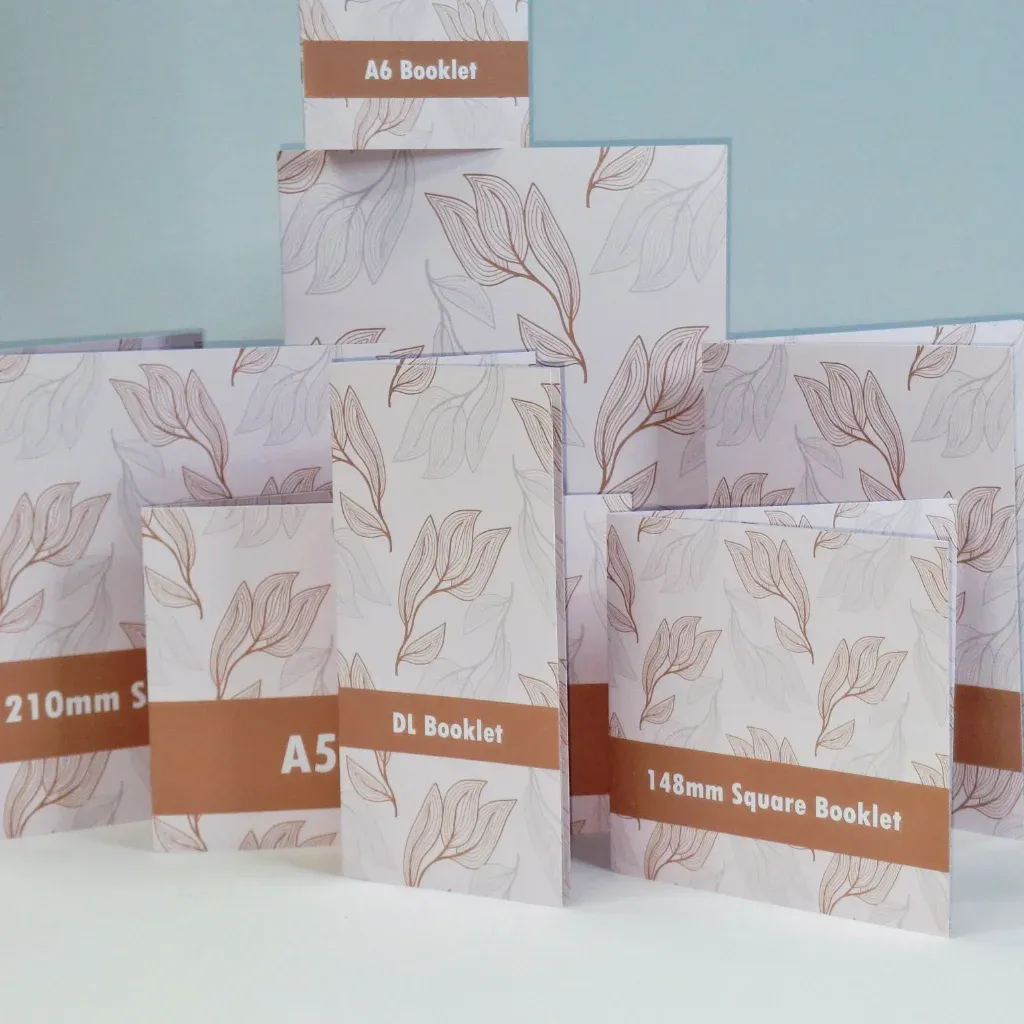
Our booklet range includes A6, A5, A4, 148 × 148mm, 210 × 210mm, DL and A5 Landscape sizes, with both stapled and spiral-bound options. Booklets are printed in-house in Tavistock, with delivery available across the UK.
Artwork tips before you send a booklet to print
A few checks during artwork preparation can prevent avoidable layout issues later.
- Allow for bleed. If a background colour or image should reach the edge, extend it beyond the finished trim line. This helps avoid a narrow white edge after trimming.
- Keep important content inside safe margins. Leave breathing room around text, logos and page numbers, especially near the outside edges.
- Give the spine some space. Keep text away from the fold so it stays readable when the booklet is open.
- Supply pages in reading order. Page one of your PDF is normally the front cover, followed by the inside front cover and the remaining pages. The print setup rearranges the pages so they fall into the right order once the sheets are printed, folded and nested. This arrangement is called imposition.
If you’re unsure how to set up the file, our in-house graphic design team can help with layout and preparing artwork for print.
The result for the trail
In this illustrative project, the booklet gave visitors a clear route through the event. The studios were numbered consistently, so readers could match each artist’s page to the trail information. The cover and inner stocks were chosen for a booklet that felt substantial without being awkward to carry.
The guides stood up to three days of typical Devon weather and handling, and the collective planned a reorder for the following year. Those practical outcomes mattered most. Visitors could find the artists more easily, and the organisers had a format they could develop for the next trail.
“A useful guide earns its place in someone’s bag by making the day easier to navigate.”
A useful takeaway for your next booklet
Start with the reader’s experience. Decide what information needs to fit, how people will handle the booklet and whether it needs to lie flat. Then settle the page count, binding, paper and artwork setup. For saddle-stitched booklets, remember that pages come in multiples of four and leave room around the fold and trim edges.
A well-planned booklet makes information easy to carry, find and use. If you’d like to talk through a print idea, pop in to our workshop at 69 West Street, Tavistock, call us on 01822 613154 or browse the Booklets page.
Meta title
The Trail Guide That Went the Distance, A Print Job Deep Dive
Meta description
A print job deep dive into booklet printing, with a saddle-stitched trail guide, practical design tips and in-house printing in Tavistock, Devon.