
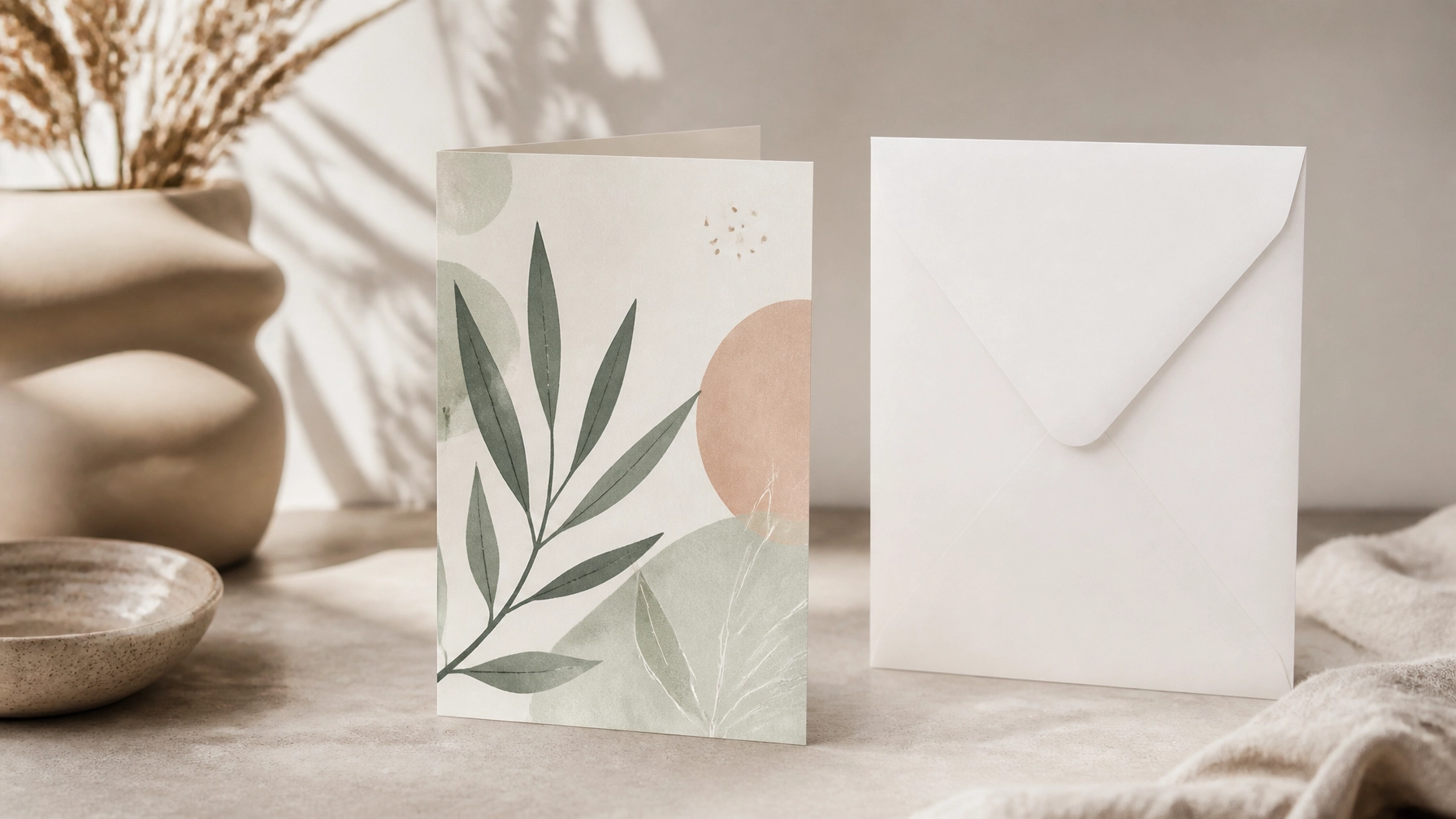
A6 greeting cards are a practical, versatile format for thoughtful personal messages, seasonal correspondence and small business print ranges. The finished folded card measures approximately 105 × 148mm, making it a compact portrait format that is easy to handle, display, post and package.
The card is produced from an A5 sheet measuring 148 × 210mm. It is printed flat, scored down the middle and folded to create the finished A6 card. For artwork, the current product instructions require a file measuring 154 × 216mm, including 3mm bleed on every edge.
That flat sheet becomes the front cover, back cover and two inside pages. Artwork therefore needs to account for the fold, page orientation and the way the design continues across the complete sheet.
What size is an A6 greeting card – the essential measurements
For the portrait format covered in this guide, the key measurements are:
- Finished folded size – approximately 105 × 148mm
- Flat sheet before folding – A5, measuring 148 × 210mm
- Artwork size with bleed – 154 × 216mm
- Bleed – 3mm on every edge
- Fold – scored down the middle of the A5 sheet
- Envelope – a matching envelope is supplied with the card
The finished card is portrait and visibly taller than wide. It is not a square card, landscape card, A7 card or A5 card.
When the card is opened, the flat artwork covers four areas:
- The front cover
- The back cover
- The left inside page
- The right inside page
A design can be simple, such as a full-colour front image with a blank interior. Alternatively, it can include a message, illustration, business details or supporting information inside the card.

An A6 card offers enough space for a considered message without becoming difficult to store, display or send.
How A6 greeting cards are produced
A6 greeting cards printing starts with the larger A5 sheet rather than the finished card size. This is important when preparing a file.
The sheet is printed while flat, then scored so that it folds cleanly through the centre. The score creates the card’s spine and helps the finished front and back covers sit correctly together.
The artwork must extend beyond the final trim area by 3mm on each edge. This is called bleed. It gives the printer a small amount of extra image or colour to trim away, reducing the risk of a narrow unprinted edge after cutting.
The supplied artwork should therefore measure:
- 210mm plus 3mm bleed on both sides
- 148mm plus 3mm bleed on both sides
- 154 × 216mm overall
The fold should also be considered carefully. Avoid placing important text, faces, logos or fine details directly on the centre fold. Keeping key elements approximately 3–5mm inside the trim edge is a sensible working margin, although the live product instructions should always take priority.
Choosing the card media – what gsm means

The product page offers several media options. GSM means grams per square metre, and it provides a useful guide to the weight and thickness of the material. In general, a higher gsm card feels heavier and more substantial, although the material type also affects its texture and rigidity.
Available media includes:
- 300gsm Uncoated – a natural, writable surface with a softer appearance
- 350gsm Silk – a smooth surface with a subtle sheen and crisp colour reproduction
- 400gsm Artboard – a heavier, more rigid option for a premium feel
- 280gsm Kraft – a warm brown stock with a natural, handcrafted character
- 300gsm Gesso – a distinctive surface suitable for designs that benefit from added texture
The best choice depends on how the card will be used. An uncoated or Kraft card may suit a handmade-market range, while Silk or Artboard may work well for a polished business or retail collection.
The live product options also include:
- White or Kraft envelopes
- Single-sided or double-sided printing
- No Laminate
- Matt Laminate
- Gloss Laminate
- Soft Touch Laminate
- Listed despatch choices of 1 working day, 2 working days or 3–5 working days
Not every combination will necessarily be available for every order. Check the live options on the A6 greeting card printing product page before placing an order, particularly where a specific media, laminate or despatch time is important.
When A6 greeting cards are useful
The portrait A6 format is flexible enough for personal projects, retail products and business correspondence.
Personal messages
A6 folded cards are suitable for:
- Birthdays and anniversaries
- Thank-you notes
- Invitations
- Wedding stationery
- Congratulations
- Sympathy messages
- Gift messages
- Seasonal greetings
- Christmas cards
The interior gives the sender room to add a handwritten note, while the front cover can carry an illustration, photograph or carefully designed message.
Small business greeting cards
For small businesses, personalised A6 cards can support customer relationships without feeling overly formal. They may be included with an order, handed to a customer after a service or used as part of a wider correspondence programme.
Common business uses include:
- Customer appreciation cards
- Thank-you cards included with online orders
- Product inserts
- Retail and handmade-market ranges
- Appointment follow-up messages
- Seasonal business correspondence
- Corporate Christmas cards
- Branded notes for suppliers and partners
A consistent card range can also help a business present its visual identity across packaging, printed stationery and in-person customer interactions.

Artwork preparation – practical checks before ordering

Good artwork preparation reduces avoidable delays and helps the finished card match the original design.
Include 3mm bleed
Set up the artwork at 154 × 216mm. Extend background colours, patterns and images into the bleed area. Do not leave a white border unless it is an intentional part of the design.
Keep important content inside the safe area
Keep text, logos and important details away from the outside trim edge and centre fold. A 3–5mm internal margin is a useful guide for important content.
Check the fold alignment
Remember that the card is printed flat and then folded. The front cover should sit on the correct outer panel, while the inside pages should be oriented so they read naturally when the card opens.
A printed proof or a folded paper dummy can help. Print a scaled version, mark the centre fold and fold it by hand before finalising the design.
Check inside-page orientation
If the card contains a message inside, check that it is not upside down or positioned on the wrong panel. This is particularly important when supplying a PDF exported from a design programme with multiple artboards.
Supply multiple designs carefully
The ordering system cannot detect multi-page documents automatically. If your artwork contains two or more pages or designs, you must select the correct quantity when ordering.
For example, a file containing several card designs should not be assumed to represent one finished card. Several designs may be split across an order quantity where the live product options allow it, but the quantity and file structure need to be clear.
If you are unsure, contact the printing team before ordering. A short check can prevent an incorrect quantity, an unexpected layout or a delay in production.
Finishing options for different card styles

Lamination changes the appearance and feel of the outer surface.
- No Laminate keeps the natural texture of the chosen media.
- Matt Laminate reduces shine and creates a calm, understated finish.
- Gloss Laminate gives the outer surface more shine and visual contrast.
- Soft Touch Laminate creates a smooth, tactile finish suited to premium designs.
Consider whether the card needs to be written on. A non-laminated interior is generally more practical for handwritten messages, while a laminated outer cover can protect the printed design. The live product configuration should be checked for the exact combination selected.
White envelopes offer a clean and familiar presentation. Kraft envelopes bring a warmer, more natural look and can complement uncoated or Kraft card stock.
Printing A6 cards locally and across the UK
ABC Service produces print work in-house at 69 West Street, Tavistock, Devon. Local customers can arrange collection, while UK-wide delivery is available for businesses, designers, retailers and organisations elsewhere in the country.
Our wider greeting card printing category includes other formats, including A7, A5, 5×7 and square cards. Comparing the finished sizes can help when planning a coordinated range or deciding which format best suits a particular product.
For broader print requirements, visit our printing services page, which covers digital printing and other business print products. If the artwork needs professional development, our graphic design service may also be useful for creating a new card range or adapting an existing visual identity.

Summary and Takeaway
A6 greeting card printing uses an A5 sheet measuring 148 × 210mm, scored down the middle and folded to create a portrait card approximately 105 × 148mm. Artwork should be supplied at 154 × 216mm, including 3mm bleed on every edge.
The format works well for personal messages, wedding stationery, Christmas cards, customer appreciation, product inserts, retail ranges and small business greeting cards. Media choices range from uncoated and Kraft stocks to Silk, Artboard and Gesso, with envelope, printing and laminate options available through the live product page.
The most important preparation points are simple:
- Set up the correct artwork size
- Include 3mm bleed
- Keep key content away from edges and the centre fold
- Check inside-page orientation
- Select the correct quantity for multiple designs or pages
- Confirm the live options before ordering
What could an A6 card help you communicate more thoughtfully in your next personal or business message?