
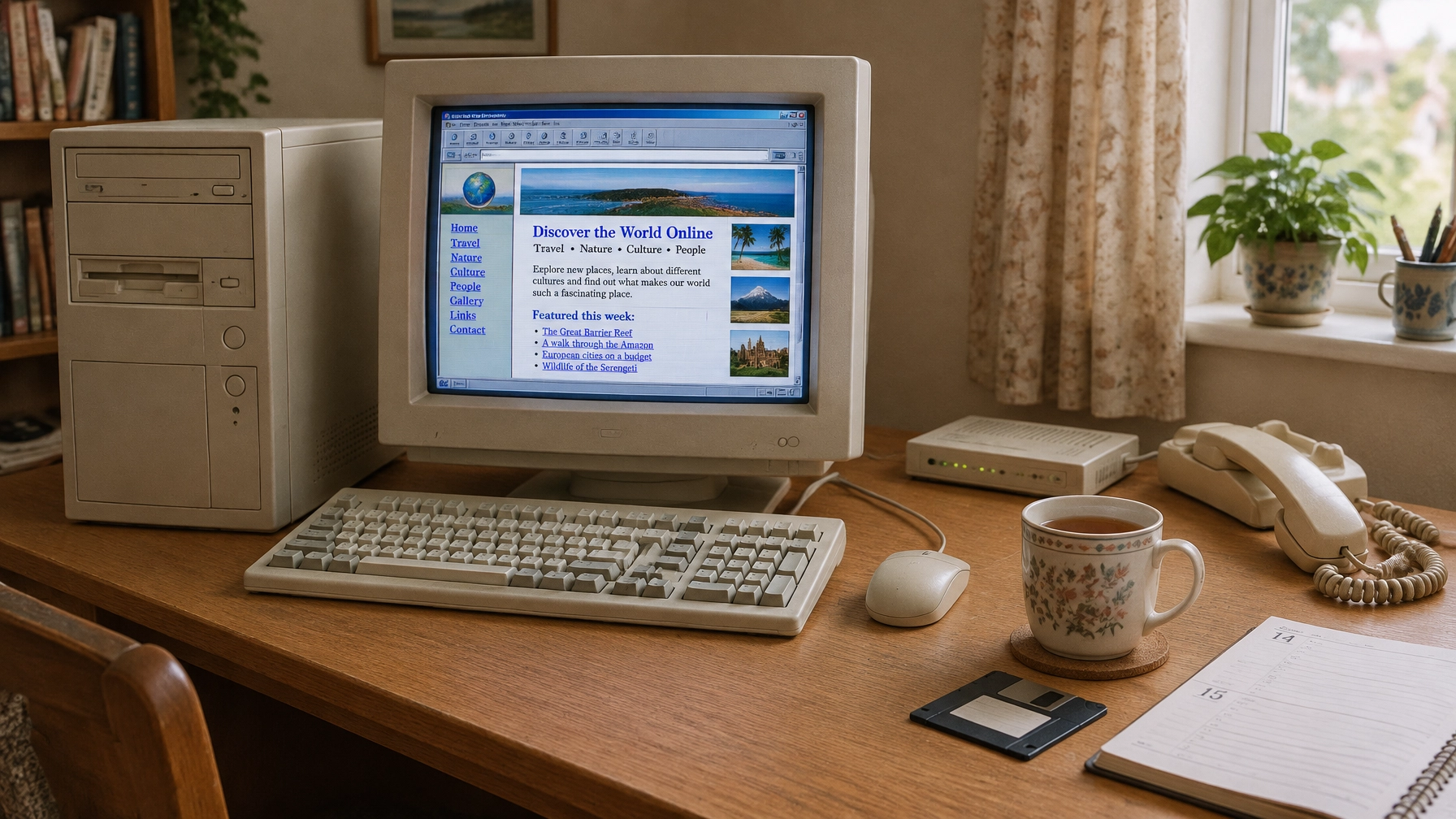
1996 was when the internet began to feel less like a place to visit and more like somewhere people were spending their time. Browsers competed to become the gateway, email followed users beyond a single computer, and flat-rate access encouraged people to stay online for longer.
The connections were still slow, the equipment still filled a desk, and a busy telephone line could bring a session to a halt. But the habits of everyday computing were changing quickly.
The browser became the front door
On 13 August, Microsoft released Internet Explorer 3.0. Netscape Navigator still held roughly three quarters of the browser market, but the balance began to move. Microsoft gave Internet Explorer away and bundled it with Windows, and its usage climbed sharply within months.
That shift made the browser more than a piece of software. It became the front door to the web. Competition was no longer just about which browser had the more appealing features; distribution mattered too. A browser arriving with the operating system could reach people who might never have gone looking for one.
The Computer History Museum’s 1996 timeline gives a useful snapshot of a year when the web was becoming an increasingly everyday part of computing.
Email stopped belonging to one computer
Hotmail launched commercially on 4 July. Founders Sabeer Bhatia and Jack Smith chose the date to signal independence from email tied to an internet provider. Its original styling, HoTMaiL, nodded to HTML, the language used to build web pages.
The idea was simple and significant. Open a browser, sign in, and reach your inbox from another computer. There was no need to install the usual email software on that particular machine. Hotmail was free and supported by advertising; its archived About page described the ambition to make email accessible through a web browser from anywhere.
Email was beginning to travel with the person, rather than stay on the desktop. Microsoft bought Hotmail in 1997.
Today, browser-based email feels ordinary, but the underlying idea remains useful: access depends on a service and a connection, not one particular machine. ABC Service also provides email hosting for organisations that want email associated with their own domain.

A number could mean someone was there
On 15 November, Israeli company Mirabilis launched ICQ. It became the first widely adopted stand-alone instant messenger, giving users unique numbers and a way to see who was online.
The name came from “I seek you”, but the more interesting change was presence. Email could wait for a reply. ICQ suggested that somebody was there now, available for a quick message. That brought a new social question with it: if a name appeared online, was it an invitation to talk?
The etiquette had to be worked out as people used the service. A number became an identity, and being visible became part of communicating. The web was no longer only a collection of pages and inboxes; it was starting to show who was connected.
A flat fee, and the sound of a busy line
In October, America Online (AOL) announced an unlimited plan for $19.95 a month, switching to it on 1 December. In December alone, half a million new subscribers joined. Average use per member more than doubled, and the network struggled with outages.
This was an American example, not a description of every country’s internet access. What mattered more broadly was the behaviour it encouraged. When the price stopped rising with each extra hour, people had a reason to stay online longer. The network, however, had to absorb the rush.
For anyone using dial-up, time online still meant using the telephone line. Waiting for someone to finish a call before you could connect became a familiar domestic negotiation. Pricing changed behaviour faster than the infrastructure could keep up. A contemporary New York Times report captured the strain around AOL’s flat-rate shift.

Kasparov, Deep Blue and a question that remains
In February, IBM’s Deep Blue played world chess champion Garry Kasparov in Philadelphia. Deep Blue won the first game, marking the first time a computer had beaten a reigning world champion at classical time controls. Kasparov then won the six-game match 4–2.
“I could feel, I could smell, a new kind of intelligence across the table.”
Garry Kasparov
The result did not settle what machine intelligence meant. Deep Blue’s performance raised a question that remains relevant: when a computer produces a strong result, what are we recognising: speed, calculation, intelligence, or some combination? IBM’s history of Deep Blue puts the 1996 match in context, including the computer’s game-one win and Kasparov’s overall victory.
It was a remarkable contest, but not a reason for either hype or alarm. It showed what a computer could achieve in a defined task, and left the larger question open.
Computing began to leave the desk
The Palm Pilot 1000, shipped in March by U.S. Robotics’ Palm Computing, brought a monochrome touchscreen and Graffiti handwriting input into a handheld organiser. Users could synchronise it with a PC or Mac with one touch. It was marketed as a connected organiser, rather than a PDA.
In August, Nokia launched the 9000 Communicator. It opened like a clamshell to reveal a full QWERTY keyboard and a screen, and could handle email and basic web browsing. It was one of the earliest devices of its kind, an attempt to combine phone and computing functions in one portable object.
Neither device made the desk disappear. Instead, each offered a glimpse of computing becoming more personal and mobile. Carrying information with you was becoming part of the design brief.
The quiet plumbing behind the peripherals
The USB 1.0 specification was released on 15 January by a group including Compaq, DEC, IBM, Intel, Microsoft, NEC and Nortel. It offered low-speed transfers of 1.5 Mbit/s and full-speed transfers of 12 Mbit/s, and was designed to replace the tangle of serial and parallel ports.
USB was not the showiest development of the year. It was the practical one: a shared standard intended to make connecting devices less complicated. The Engineering and Technology History Wiki’s USB milestone entry records the specification’s release and its aims.
It is a change many people barely noticed at the time, but one that became part of how computers and peripherals work together.
Games and discs reach the high street
Nintendo 64 arrived in Japan on 23 June and in North America on 29 September. The UK and Europe followed on 1 March 1997, so it was not a 1996 European launch. Meanwhile, 3dfx began selling Voodoo Graphics chips for PC 3D acceleration, bringing dedicated 3D graphics into the PC gaming conversation.
Home video was changing too. Toshiba’s first DVD-Video player, the SD-3000, went on sale in Japan on 1 November for ¥77,000, alongside Panasonic’s first players. Toshiba’s September announcement set out the launch date and price.
These were examples of high-street hardware catching up with ideas that had been taking shape. Games and films were giving people new reasons to pay attention to what their machines could do.
A search project begins quietly
One of the year’s quietest starts came at Stanford, where Larry Page and Sergey Brin began work on BackRub, a search project that ranked pages by the links pointing to them. It was a seed, not a Google launch; Google itself came later, in 1998. The US National Science Foundation’s account of Google’s origins describes how the project explored links as a way to assess pages.
The year also brought quieter scientific firsts. Dolly the sheep was born at the Roslin Institute on 5 July, the first mammal cloned from an adult cell. The news reached the world in February 1997, as the next instalment of this series will explore.
The year’s ingredients
- Browsers moved from feature rivalry towards competition over reach and distribution.
- Webmail made an inbox accessible through a browser, not just one computer.
- Instant messaging made online presence visible and immediate.
- Flat-rate access encouraged longer sessions, putting pressure on networks.
- Deep Blue made a landmark game-one breakthrough, while Kasparov won the match.
- Handheld organisers and communicators began taking computing beyond the desk.
- USB set out a common way to connect devices.
- Games and DVD players brought new capabilities into homes.
- BackRub began exploring links as a way to rank web pages.
The legacy of 1996
1996 was not the year everything became instant or portable. Connections could still be slow, and a computer remained a substantial piece of furniture. But the year brought together changes that made the internet busier: easier access, more ways to communicate, and pricing that encouraged people to stay connected.
It also showed how much everyday computing depends on unglamorous foundations. Browsers needed distribution, networks needed capacity, and devices needed ways to connect. The ideas were moving quickly; the infrastructure was catching up.
For a modern look at how computers are supported today, visit our Computer and IT Support Hub.
Next time, 1997
The next instalment follows the story into 1997, when some of 1996’s unfinished ideas came into sharper focus. The internet was getting busier, and the question was what people would do with all that connection.
Meta title
Year by Year, A Tech Odyssey – 1996 and the Year the Internet Got Busy
Meta description
Explore how 1996 made the internet busier, from browser rivalry and webmail to instant messaging, flat-rate access and Deep Blue’s chess match.
Excerpt
In 1996, browsers competed for the front door to the web, email escaped the desktop and flat-rate access encouraged people to stay online longer.
Suggested tags
1996 technology, technology history, internet history, browser history, Hotmail, ICQ, AOL, Deep Blue, Palm Pilot, USB, Nintendo 64, DVD history