
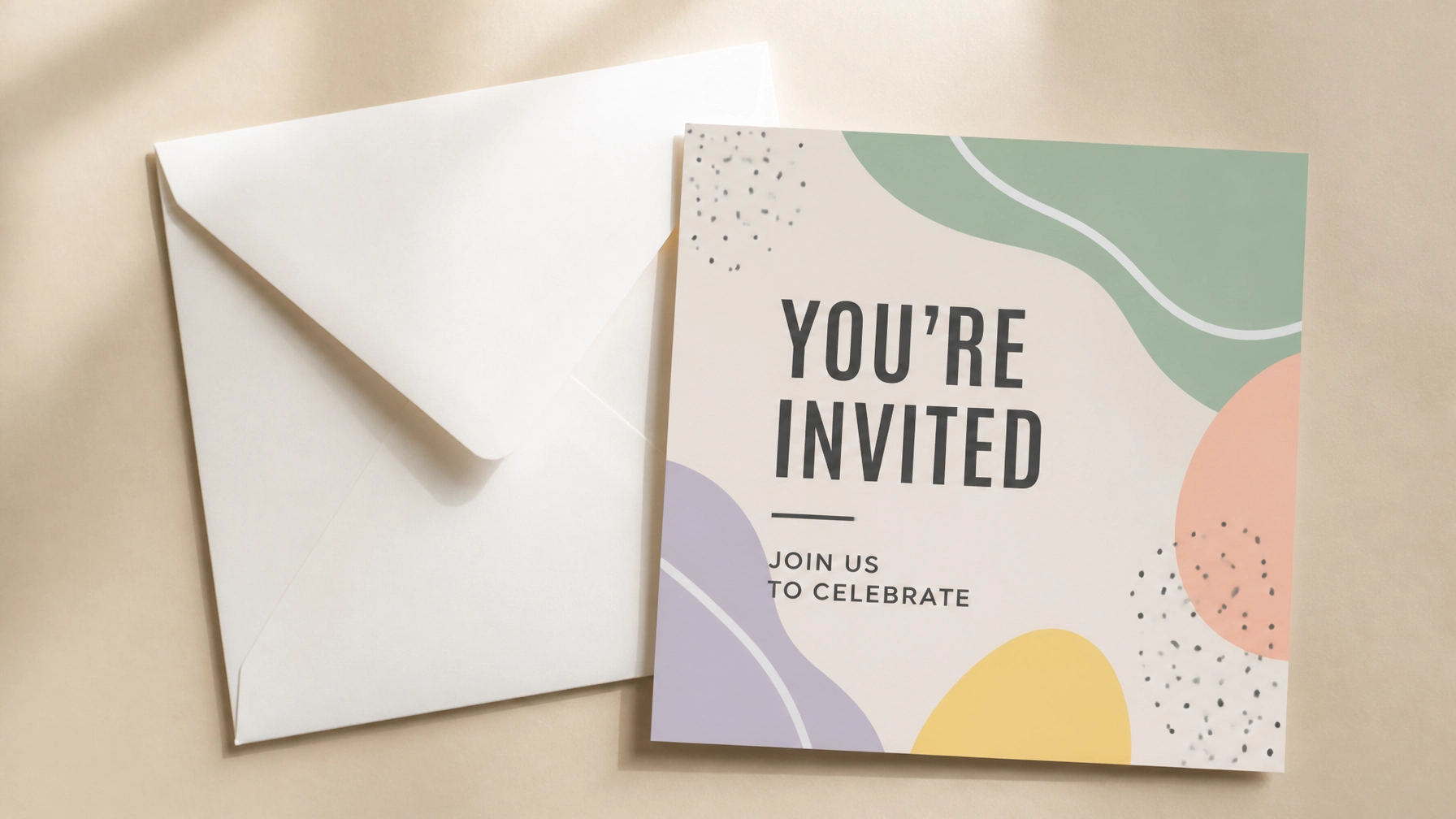
A 148 × 148 mm invitation is a single, flat square sheet with equal sides. It offers a balanced canvas for concise event details, strong typography, photography, illustrations and colour-led design.
The finished invitation measures 148 × 148 mm. Artwork should be supplied at 154 × 154 mm, including 3 mm of bleed on every edge.
This format works particularly well when the visual identity of an event matters. The equal-sided layout gives designers room to create a confident composition without needing a large amount of text. It suits square wedding invitations, square birthday invitations and personalised square invitations for a wide range of occasions.
Why choose a square invitation format
A square layout gives every edge the same visual importance. This can make the design feel considered and modern, particularly when the invitation includes a photograph, illustration, logo or bold colour blocks.
The format is suitable for:
- Weddings and engagement parties
- Birthdays and milestone celebrations
- Anniversaries
- Graduations
- Christenings and family gatherings
- Private celebrations
- Corporate events and launches
- Business open days
- Community events and fundraising activities
A square invitation can also make a useful foundation for a wider event stationery range. The same colours, typefaces and graphic elements can be carried through to signage, menus, table stationery, posters or social media artwork.
“A square format creates visual balance before the first word is even read.”
The important point is to treat the finished size as a design feature. Rather than trying to fill every part of the sheet, use the equal-sided canvas to create a clear focal point and a comfortable reading order.

Understanding the finished size and artwork size
The finished invitation is 148 × 148 mm. This is the size after trimming.
Your artwork file must be larger because it needs to extend beyond the final cut line:
- Finished invitation size : 148 × 148 mm
- Bleed : 3 mm on every edge
- Supplied artwork size : 154 × 154 mm
Bleed is the extra area around the outside of the artwork. It is trimmed away during production and allows background colours, photographs and illustrations to reach the edge cleanly.
Without bleed, small variations during trimming could leave a narrow unprinted line along an edge. Extending the artwork to 154 × 154 mm gives the production team the extra image area needed for a clean finish.
Keep important details inside a safe margin
The safe margin is the space between the finished edge and important content. Keep names, dates, addresses, RSVP information, logos and small decorative details comfortably inside the 148 × 148 mm finished area.
As a practical guide, we recommend keeping key content at least 5 mm inside the trim edge. This creates an approximate safe area of 138 × 138 mm.
A 6 mm margin can be useful where the design includes small type or highly detailed information. The exact layout will depend on the design, but the principle is straightforward:
- Backgrounds and edge-to-edge artwork extend into the bleed
- Important text stays inside the safe margin
- No essential information should sit close to the trim line
Designing a balanced square composition

Square invitation printing rewards careful layout. Because the width and height are equal, the design can become crowded if every element is centred or given the same visual weight.
Consider using:
- A strong title near the upper third of the sheet
- One clear image or illustration as the main focal point
- Asymmetrical blocks of colour
- A restrained type hierarchy
- Generous space around the event details
- One consistent alignment system
- Short sections rather than dense paragraphs
A square invitation does not need to be symmetrical to feel balanced. A large lavender block on one side can be balanced by a small charcoal heading on the other. A photograph can sit opposite a compact information panel. The aim is to guide the eye naturally.
For a wedding, the front may feature the event title and a photograph or illustration. For a birthday, a playful number or bold colour treatment may work well. For a corporate launch, the square format can present a logo, campaign message and essential event details in a compact, memorable way.
Planning the front and reverse
The live product page allows you to select single-sided or double-sided printing. Choose the arrangement that best suits the amount of information and the way guests will use the invitation.
Single-sided printing
Single-sided printing works well when the invitation needs to be concise. It can suit:
- A short private celebration
- A simple event announcement
- A photographic invitation
- A design-led corporate open day
- An invitation with a QR code linking to further information
Keep all required details visible on the printed side. Include the event name, date, time, location, contact details and RSVP instructions where relevant.
Double-sided printing
Double-sided printing gives you more space without changing the finished size. The front can focus on the visual message, while the reverse carries practical information such as:
- Full event details
- RSVP instructions
- Dietary or accessibility information
- Parking guidance
- Contact details
- A short message from the host or organisation
Proof both sides carefully. Check that the reverse is oriented correctly for the way the invitation will be handled and that no information has been placed too close to the edge.

Choosing the right media
The product page offers a broad range of media. The term gsm means grams per square metre. In simple terms, a higher gsm usually indicates a heavier and more substantial sheet, although the finish and material also affect how it feels.
Available media include:
- 130gsm Silk
- 150gsm Silk
- 250gsm Silk
- 350gsm Silk
- 120gsm Uncoated
- 300gsm Uncoated
- 140gsm Gesso
- 300gsm Gesso
- 400gsm Artboard
- 280gsm Kraft
- 770gsm Magnetic
Silk media provides a smooth printed surface with a subtle sheen. Uncoated media has a more natural feel and can suit informal, traditional or handwritten styles. Gesso options offer a textured surface, while Kraft can support a rustic or sustainability-led visual direction.
The 400gsm Artboard option provides a more rigid feel. The 770gsm Magnetic option is a specialist choice where the invitation is intended to have a magnetic finish. The available choice may depend on the wider configuration selected, so check the live product options before ordering.
Lamination and envelope choices
You can select from:
- No laminate
- Matt Laminate
- Gloss Laminate
- Soft Touch Laminate
Matt laminate reduces surface reflection and can suit photographs, modern typography and understated colour palettes. Gloss laminate can add vibrancy and surface protection. Soft Touch Laminate gives a smooth, tactile finish.
The live product page also lists:
- No envelopes
- White envelopes
- Kraft envelopes
A square envelope can support the format visually and provide a practical way to send or present the invitation. Check the available envelope choice alongside the selected invitation specification before completing the order.
Preparing artwork correctly
Before uploading your file, use this checklist:
- Set the document to 154 × 154 mm
- Include 3 mm bleed on every edge
- Use a square orientation
- Keep key text inside a safe margin of around 5 mm
- Check the finished size will be 148 × 148 mm
- Confirm whether you need single-sided or double-sided printing
- Check front and reverse artwork separately
- Proof names, dates, times, addresses and contact details
- Confirm photographs are sharp enough for print
- Check that logos and text are readable at the finished size
- Export the artwork in the format requested by the ordering system
The ordering system cannot automatically detect every multi-page document. If you are supplying multiple pages or designs, choose the correct quantity for the number of printed invitations and confirm how the files should be handled.
Multiple designs can be useful for:
- Different guest versions
- Several event dates
- A coordinated event range
- Separate invitations for different sessions
- Variations for sponsors, partners or VIP guests
Where the live options allow multiple designs, provide clear filenames and explain which file relates to each version.
When professional design support is useful
A supplied design is often the most efficient option when your artwork is already complete. However, a design service can be useful when you have the wording, photographs or brand assets but need help creating a polished layout.
Our graphic design service can help with:
- Choosing a suitable square composition
- Creating a consistent visual style
- Preparing print-ready artwork
- Balancing typography and imagery
- Adapting a design for different event materials
The design should always be approved carefully before production. We recommend checking the final proof as the finished 148 × 148 mm format may feel different from the artwork displayed on a large computer screen.
Ordering square invitation printing in the UK

You can view the live specifications and place an order through our 148 × 148 invitation printing product page.
The product page includes options for media, quantity, lamination, printing sides, envelopes and despatch or collection. Listed despatch choices include 3–5 working days, 2 working days and 1 working day, subject to the selected configuration and the live availability shown when ordering.
We produce invitations in-house at 69 West Street, Tavistock, Devon. Local customers can arrange collection, while our printing service supports UK-wide delivery.
If you are comparing formats, our A6 invitation printing offers a more compact rectangular option, while A5 invitation printing provides a taller canvas for longer wording or larger imagery. You can also browse the wider invitation printing category for other available formats.
Summary and takeaway
Square invitation printing gives event stationery a clear, balanced and design-led format. The finished invitation measures 148 × 148 mm, while supplied artwork should measure 154 × 154 mm to include 3 mm bleed on every edge.
The most important preparation steps are:
- Design for an equal-sided 148 × 148 mm finished canvas
- Supply artwork at 154 × 154 mm
- Keep important content inside a safe margin
- Plan the front and reverse if using double-sided printing
- Choose media and finishes to suit the event
- Proof every detail before production
- Confirm quantities carefully when supplying multiple designs
From weddings and birthdays to launches, open days and community events, the square format provides a memorable way to present essential information with visual clarity.