
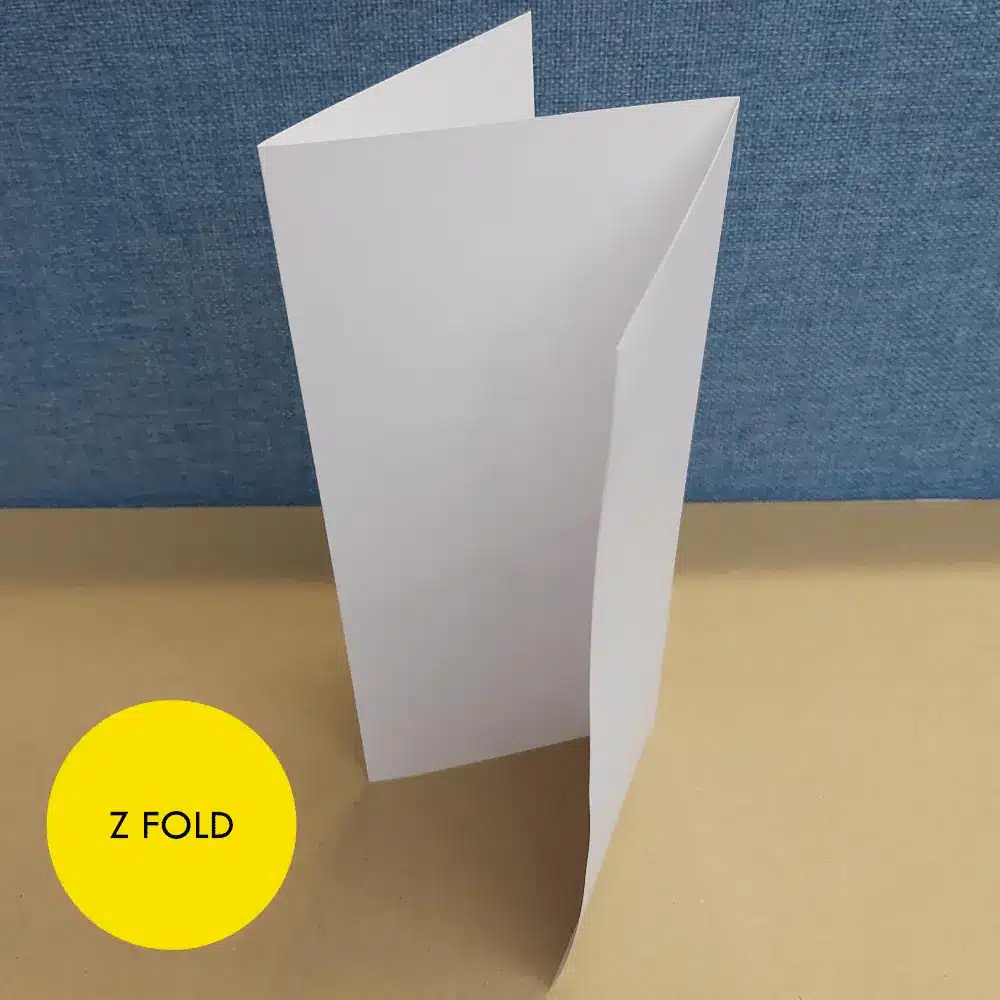
A Z-fold leaflet is designed for information that needs a clear beginning, middle and end. The sheet opens in alternating directions, creating a distinctive Z-shaped panel arrangement when viewed from above.
This makes the format useful for businesses, organisations and community groups that want to guide readers through connected sections without presenting everything as one dense page.
Our Z-fold leaflet printing service is available in A5, A4 and A3 flat sheet sizes, with a choice of paper stocks, laminates, quantities and despatch options.
What Z-fold leaflet printing means
A Z-fold, also known as a zig-zag fold, starts as one flat sheet. It is folded in alternating opposite directions so that the panels move backwards and forwards rather than folding into a single central crease.
When viewed from above, the folded leaflet forms a shape similar to the letter Z.
The selected paper size refers to the flat, unfolded sheet:
- A5 – 148 × 210mm flat size
- A4 – 210 × 297mm flat size
- A3 – 297 × 420mm flat size
The finished folded format is smaller than the selected flat size because the sheet is divided into connected panels.
A Z-fold is not the same as:
- A single centre-fold leaflet
- A double-fold leaflet
- A C-fold leaflet
- An accordion or concertina leaflet
- A gatefold leaflet
The product-page reference image shows the intended Z-fold construction, with the panels alternating in opposite directions. It is the panel direction and back-and-forth opening that define this format.
“A Z-fold works best when every panel has a clear job and the full sequence still tells one connected story.”
Why a zig-zag layout can work well
The alternating fold gives readers a natural route through the content. Each panel can introduce a separate point while remaining connected to the sections before and after it.
This is particularly useful when your information:
- Moves from an introduction to supporting details
- Explains a process in stages
- Presents a range of services or products
- Follows a timeline
- Divides a wider subject into clear categories
- Leads readers towards a final action or contact point
A flat flyer often asks the reader to decide where to start. A Z-fold can provide more direction. The front panel can introduce the subject, the middle panels can develop the message and the final panel can provide contact information, next steps or supporting details.
The arrangement also allows the leaflet to be opened partially or fully. Someone viewing it quickly can scan the main sections, while a reader who wants more detail can unfold the complete sheet.
Practical uses for Z-fold brochures
Z-fold brochure printing is suitable for a wide range of business, public information and promotional applications.
Company and service information
A company leaflet can use separate panels for:
- Who the organisation is
- Main services
- Key benefits
- Areas covered
- Frequently asked questions
- Contact details
This approach avoids squeezing every service into one crowded block of text.
Product ranges
A product range can be divided into logical groups, with each panel covering a product family, application or customer need. Short descriptions, specifications and supporting images can then be arranged in a more manageable sequence.
Events and exhibitions
Z-fold leaflets are useful for event information, especially when readers need to understand several related details. Panels could cover:
- The event overview
- Important dates
- Activities or sessions
- Venue information
- Practical arrangements
- Follow-up contact details
They are also convenient exhibition handouts because the folded format is easy to distribute and carry.
Property and travel information
Property details, visitor information and travel guidance often benefit from a structured journey. A Z-fold can separate locations, features, directions, highlights and useful contacts while still allowing the reader to open the leaflet fully.
Fundraising and community campaigns
Community groups and charities can use the panels to explain the issue, introduce the campaign, show how support is used and provide clear ways to get involved.
Training material and sequential content
The format is well suited to training summaries, process guides, project timelines and step-by-step promotional content. The alternating panels can represent stages in a sequence without making the document feel like a long continuous sheet.
Choosing the paper and finish
The live product configuration includes a broad selection of media. Availability depends on the options selected, so we recommend checking the current configuration before preparing or ordering artwork.
Available media includes:
- 130gsm Silk
- 150gsm Silk
- 250gsm Silk
- 350gsm Silk
- 120gsm Uncoated
- 300gsm Uncoated
- 140gsm Gesso
- 300gsm Gesso
- 400gsm Artboard
- 280gsm Kraft
- Waterproof 260gsm, 195 Mic
- Waterproof 365gsm, 270 Mic
What gsm means
GSM means grams per square metre. It describes the weight of the paper or board.
In simple terms:
- Lower gsm materials are generally lighter and more flexible
- Higher gsm materials are generally thicker and more substantial
The paper type also affects the appearance and feel. Silk, Uncoated, Gesso, Kraft and waterproof media each provide a different result.
What micron means
Micron describes thickness. A higher micron value generally indicates a thicker or more rigid waterproof material.
The product includes waterproof options at 195 Mic and 270 Mic. These may be useful where the leaflet needs additional resistance to moisture or heavier handling.
Lamination choices explained
The product configuration includes four lamination options:
- No Laminate – the chosen paper or board remains unlaminated
- Matt Laminate – reduces shine and provides a muted, professional appearance
- Gloss Laminate – adds a brighter, reflective finish that can make colours appear more vivid
- Soft Touch Laminate – creates a smooth, tactile surface with a premium feel
Matt, gloss and soft touch lamination add production time. The live product page identifies these options as adding approximately one to two days, so check the current details when selecting your requirements.
Folded or flat supply
The live configuration offers Folded or Flat as a finishing choice.
The following media are supplied folded:
- 130gsm Silk
- 150gsm Silk
- 120gsm Uncoated
- 140gsm Gesso
Other media are supplied flat but creased for easy folding. This can be useful when you want to complete the folding closer to the point of distribution or when the material requires a flatter delivery format.
The product description states that the leaflet is printed on both sides. The current live configuration shows Folded or Flat, rather than a separate single-sided or double-sided selector. Please check the live options and contact us if you need to confirm how your chosen specification will be produced.
Preparing artwork for a Z-fold
Good artwork preparation helps the design follow the physical fold accurately.
Start with the selected flat size
Begin with the A5, A4 or A3 flat sheet size selected in the product configuration. Add 3mm bleed on every outer edge of the document.
The bleed allows the background colour or image to extend beyond the trim area, reducing the risk of a narrow white edge after trimming.
Plan the alternating panel order
A Z-fold does not read like a simple left-to-right page spread. The panel order changes when the sheet is folded.
Before designing, decide:
- Which panel becomes the front
- Which panel is the back
- Where the inside sequence begins
- Which direction each fold takes
- How the content reads when the leaflet is partly opened
- How the reverse side connects to the front
Keep each panel focused on one main point. Avoid treating the entire flat sheet as one uninterrupted poster.
Keep important content away from creases
Do not place essential text, logos, faces or small details directly over a crease. Fold position can vary slightly during production, and content near a crease may be harder to read or may appear visually interrupted.
Use sensible safe margins around:
- Headings
- Contact details
- Small text
- Product specifications
- QR codes
- Important calls to action
Make a paper mock-up
A simple full-size paper mock-up is one of the most useful checks you can make.
Print the design at the selected flat size, trim it if necessary and fold it in the intended Z shape. This lets you check:
- The front panel
- The reading order
- The reverse-side orientation
- Panel alignment
- Text direction
- Image placement
- Whether the fold interrupts important content
Allow for normal fold and trim tolerances. A printed proof or digital proof can also help identify problems before production.
Quantities and despatch options
The live configuration supports quantities from 1 to 10,000, making the format suitable for a small local campaign, a business launch, an exhibition or a larger distribution project.
Available despatch and collection choices include:
- 3–5 working days
- 2 working days
- 1 working day
The exact availability may depend on your selected paper, finish, quantity and folded or flat preference. Check the product configuration before placing an order, particularly when working to an event or campaign deadline.
Local production with UK-wide delivery
ABC Service produces print work in-house at 69 West Street, Tavistock. Local customers can arrange collection, while UK-wide delivery is available for organisations elsewhere in the country.
Our wider leaflet printing service includes a range of fold formats and paper choices. You can also explore our main printing services or request support with layout and artwork through our graphic design service.
If a different fold better suits your content, the available alternatives include:
- Single-fold leaflet printing
- Double-fold leaflet printing
- Accordion-fold leaflet printing
- C-fold leaflet printing
- Gatefold leaflet printing
Summary and Takeaway
Z-fold leaflet printing uses a flat A5, A4 or A3 sheet folded in alternating directions to create a clear zig-zag arrangement. It is a strong choice for information that benefits from a structured, back-and-forth reading journey.
Before ordering, check:
- The selected flat paper size
- The 3mm bleed on every outer edge
- The panel order and front cover
- Safe margins around all creases
- The selected media and lamination
- Whether the leaflet will arrive folded or flat
- The required quantity and despatch time
For reliable results, build a full-size paper mock-up and confirm the live configuration before submitting artwork. You can then order your Z-fold leaflet printing with a clearer understanding of how the finished piece will look, open and read.