
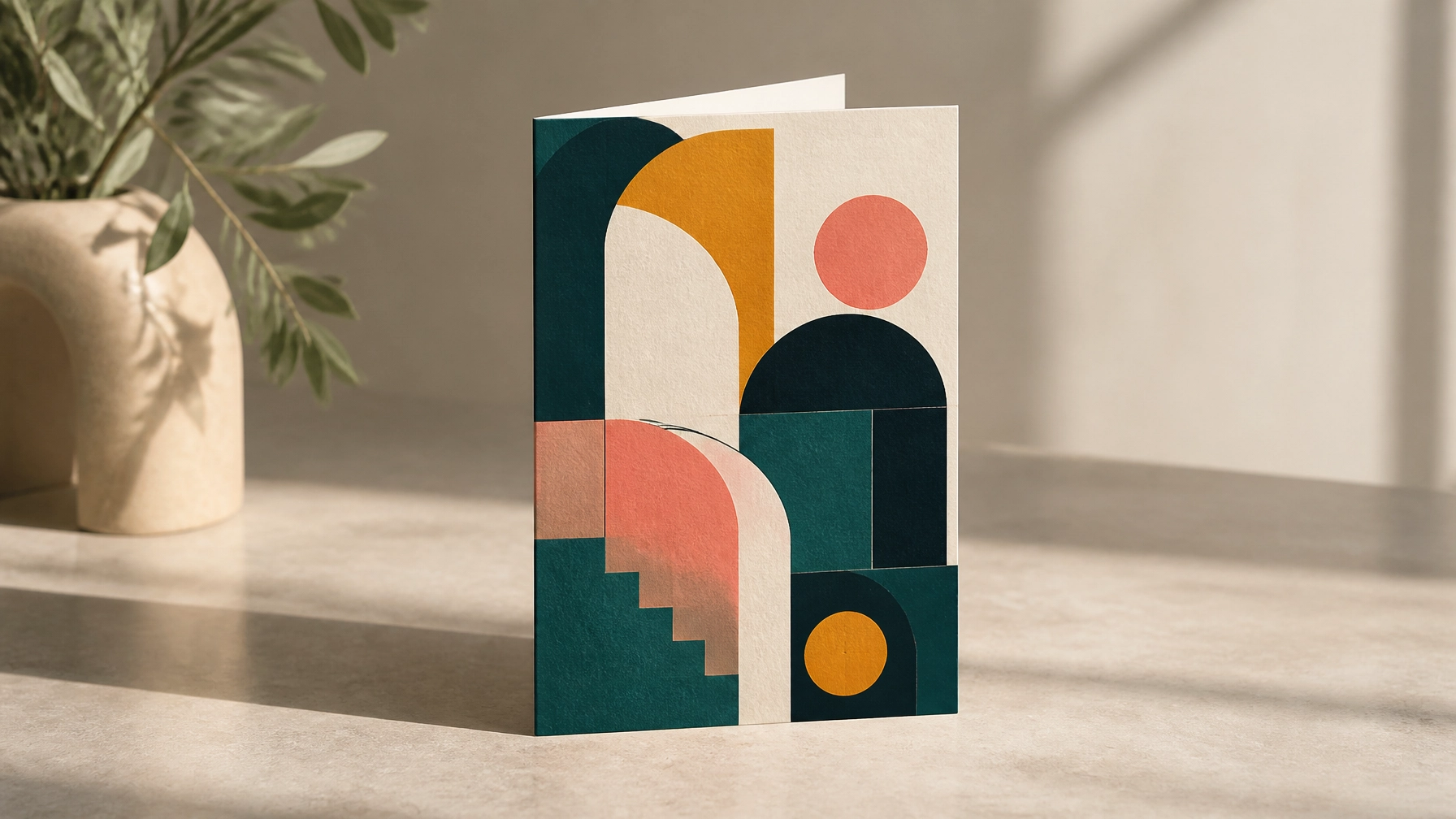
A 5×7 folded greeting card has a finished size of approximately 127 × 178mm, or 5 × 7 inches. It is produced from a flat 10×7 sheet measuring 254 × 178mm, scored down the middle and folded into a portrait card.
That familiar format gives designers enough room for a strong front cover, a considered reverse and a useful inside message area without becoming difficult for retailers to display or post. It works particularly well for occasion ranges, art-led collections, business greetings and personalised card designs.
This guide explains how 5×7 greeting card printing works, what artwork to supply and how to choose the right media and finishing options for your project.
What size is a 5×7 folded greeting card?
The finished folded card measures approximately:
- 127mm wide
- 178mm high
- 5 × 7 inches
- Portrait orientation
Before folding, the card is printed on a flat 254 × 178mm sheet. This is the equivalent of a 10×7 sheet. A score is placed down the centre of the sheet, allowing it to fold accurately into the finished 5×7 format.
Artwork should be supplied at 260 × 184mm, including 3mm bleed on every edge. The additional area gives the printer room to trim the sheet cleanly without leaving unwanted white edges.
The centre score is an important part of the layout. Front, back and inside panels should be planned around the fold rather than treated as one uninterrupted image.

“A familiar format gives creative work a useful balance of presence, practicality and shelf appeal.”
How 5×7 greeting card printing works
The production process is straightforward, but the artwork needs to reflect the finished folded format.
A typical card moves through these stages:
- Artwork is prepared at 260 × 184mm, including 3mm bleed.
- The artwork is imposed on a flat 10×7 sheet.
- The sheet is digitally printed on the selected card stock.
- The sheet is scored down the centre.
- The printed sheet is folded to create the finished 127 × 178mm card.
- The card is checked, packed with the selected envelope option and despatched or prepared for collection.
The artwork should continue across the back of the card where appropriate. If you are creating a full-bleed design, colours and images must extend into the bleed area. Text, logos and other important details should remain comfortably inside the trim and fold areas.
Our 5×7 greeting cards printing service is designed for customers supplying finished artwork for production in a range of quantities.
Why this portrait format works well
The 5×7 format is large enough to make illustration and typography feel considered, while remaining compact enough for retail display, mailing and storage.
It can suit:
- Birthday card ranges with bold illustration or expressive lettering
- 5×7 Christmas cards with seasonal artwork and generous message space
- Wedding, engagement and anniversary designs
- Art prints adapted into greeting card collections
- Illustration-led ranges from independent designers
- Customer thank-you cards for retailers and makers
- Business greetings and client correspondence
- Reseller collections containing several different designs
- Cards for galleries, visitor attractions, craft shops and lifestyle retailers
For a retailer, the format is easy to recognise and present as part of a coherent range. For a designer, it provides a useful portrait canvas without requiring an overly complex folding arrangement.
The proportion also works well for artwork that relies on a clear visual hierarchy. A title, central illustration or portrait composition can sit naturally on the front, while the reverse can carry branding, contact information or a small product message.
Choosing the right card media
The product offers several media choices. The term gsm means grams per square metre. In simple terms, a higher gsm generally indicates a heavier and more substantial sheet, although the final feel also depends on the material and finish.
Available media include:
- 300gsm Uncoated – a natural, writable surface that suits simple artwork, stationery-style designs and handwritten messages.
- 350gsm Silk – a smooth, lightly coated stock that supports crisp colour and a polished finish.
- 400gsm Artboard – a more rigid option for designs where a firm, premium feel is important.
- 280gsm Kraft – a brown, natural-looking stock that can complement handmade, rustic or environmentally conscious visual styles.
- 300gsm Gesso – a distinctive surface option for designs that benefit from a more tactile, artistic appearance.
Paper choice affects more than thickness. It changes how colours appear, how the card feels in the hand and how the design is perceived at point of sale.
A dark teal may appear particularly rich on a smooth coated stock, while a Kraft card can give muted colours a warmer, more natural character. Uncoated media can be a practical choice where customers may want to write a personal note.

Envelopes, printing and lamination choices
Depending on the live product options selected, 5×7 cards can be supplied with either white or Kraft envelopes. The envelope choice can support the overall presentation of the range. White gives a clean, classic appearance, while Kraft can reinforce a natural or craft-led identity.
Printing can be selected as:
- Single-sided printing
- Double-sided printing
Double-sided printing is useful where the reverse includes a logo, website address, artist information or a coordinated continuation of the front design.
The available lamination choices include:
- No Laminate
- Matt Laminate
- Gloss Laminate
- Soft Touch Laminate
Lamination can change the visual and tactile finish of the front of the card. Matt creates a softer, lower-reflection appearance, while gloss gives colours more visual shine. Soft touch provides a smooth, velvety feel. Lamination may add production time, so check the live options and estimated despatch date before ordering.
The product page also provides despatch choices of 1 working day, 2 working days or 3–5 working days, where available for the selected specification. These options should be checked against the chosen media, quantity and finishing combination.
Artwork preparation for 5×7 folded cards
Good artwork preparation prevents avoidable production problems. Before exporting your file, check the following points.
Set the correct document size
Create the flat artwork at:
- 260 × 184mm overall
- 3mm bleed on every edge
- Finished trim area of 254 × 178mm
- Centre score at the halfway point of the flat sheet
The 3mm bleed should contain any background colour, photography or artwork that runs to the edge. Keep essential text and logos inside a safe margin so they are not too close to the trim or fold.
Plan every panel
Think about the flat sheet as a complete spread. Depending on the fold direction and your design, plan for:
- Front cover
- Back cover
- Inside left panel
- Inside right panel
- Centre score and fold clearance
The front and back should not be positioned by guesswork. Use guides to identify the two 5×7 panels and keep important elements away from the score.
Account for the fold
A design that crosses the fold needs careful alignment. Large geometric shapes can work well, but small text or fine lines should not sit directly across the centre score.
The artwork must also continue across the back where required. Supplying only the front panel may result in an incomplete design if the product specification calls for artwork on both sides.
Check multiple designs carefully
Multiple designs can be submitted within an order quantity where the live options allow it. This is especially useful for:
- Independent retail collections
- Seasonal ranges
- Artist portfolios
- Reseller catalogues
- Mixed birthday and thank-you card orders
The ordering system cannot detect multi-page documents automatically. If your upload contains two or more pages or designs, you must choose the correct quantity for the number of printed cards required.
For example, supplying several pages does not automatically tell the system how many copies of each design you want. Confirm the quantity and file structure before placing the order.
Request or review a proof
Proofing is valuable when artwork includes fine typography, fold-sensitive elements, colour matching or a new range of designs. Check that:
- The finished size is clearly understood
- The fold is in the intended position
- The front and back are correctly orientated
- Text is not too close to the trim
- Bleed extends beyond every outer edge
- Colours and contrast are suitable for the selected media
If artwork needs creating or adapting, our graphic design service may be useful for layout development, print-ready artwork and range consistency.

A practical choice for retailers and resellers
A 5×7 card range can be structured in several ways. A retailer might group designs by occasion, colour or artist. A maker might use the format for thank-you cards included with orders. A reseller may need a series of designs that share the same dimensions and packaging while offering different artwork.

Using a consistent format across a collection can simplify:
- Display planning
- Storage and packing
- Envelope sourcing
- Price labelling
- Product photography
- Seasonal range updates
- Reseller catalogue preparation
The format is also suitable for business greetings where the design needs to feel personal without appearing informal. A carefully designed card can thank customers, acknowledge a milestone or reinforce a thoughtful relationship after a project has finished.
Printed in Tavistock and delivered across the UK
ABC Service produces printed materials in-house at 69 West Street, Tavistock, Devon. Local customers can arrange collection where appropriate, while UK-wide delivery makes the service available to businesses, designers, retailers and resellers across the country.
Our wider greeting card printing category includes other card formats for projects where a different finished proportion is more suitable. You can also explore our wider printing services for related business stationery and marketing materials.

Summary and takeaway
A 5×7 folded greeting card finishes at approximately 127 × 178mm and starts as a flat 254 × 178mm 10×7 sheet. With 3mm bleed added, artwork should be supplied at 260 × 184mm.
It is a practical, recognisable format for:
- Occasion card collections
- Christmas and seasonal ranges
- Art and illustration-led designs
- Independent retailers
- Makers and resellers
- Customer thank-you cards
- Business greetings
The most important preparation points are to plan the full flat sheet, allow for the centre score, extend artwork across the back where needed and select the correct quantity when supplying multiple designs.
For a format that balances display appeal, creative flexibility and straightforward production, 5×7 greeting card printing remains a dependable choice. What could your next card range communicate more clearly if the format gave the design room to breathe?